Showing posts with label Marcus J. Borg. Show all posts

Friday, December 16, 2022

One of my new books

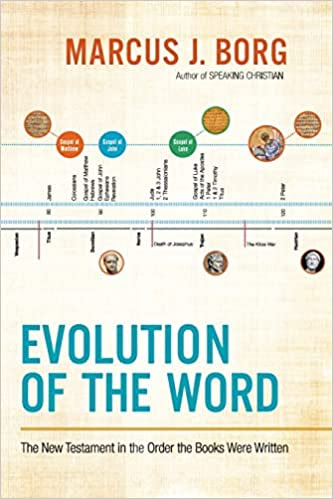
Evolution of the Word: The New Testament in the Order the Books Were Written ~ by Marcus J. Borg, foreword by Bishop Lowell Erdahl, 2012, religion, viii + 593 pages

Borg presents the New Testament books in the chronological order in which they were written, and highlights how what began as a radical Jewish faith transformed itself into Christianity.  He emphasizes the vital importance of seeing the documents in their ancient setting and provides valuable contextual commentary on each of the twenty-seven books of the New Testament.

Huh, this is the first I've heard of this book, which was among the books I inherited from Donna after she died.  I'm surprised because Borg is one of my favorite authors, and he wrote my favorite theological book:  The Heart of Christianity.

Sunday, December 12, 2021

Books I'll remember

I posted about "15 books that will always stick with me" on Facebook in 2009.  I decided to do it again, updating that list to include books that I've read in the last dozen years.  So here are 15 books, in alphabetical order, that I think will always stick with me:
  1. Agape Love: A Tradition Found in Eight World Religions ~ by John Templeton, 1999
  2. The Gnostic Gospels ~ by Elaine Pagels, 1979
  3. The Great Transformation: The Beginning of Our Religious Traditions ~ by Karen Armstrong, 2006
  4. The Heart of Christianity: Rediscovering a Life of Faith ~ by Marcus J. Borg, 2003
  5. Herland ~ by Charlotte Perkins Gilman, 1915
  6. Honest to God ~ by John A. T. Robinson, 1963
  7. Little Women ~ by Louisa May Alcott, 1868
  8. Miss Rumphius ~ by Barbara Cooney, 1982
  9. My Sister's Keeper ~ by Jodi Picoult, 2003
  10. The Mythmaker: Paul and the Invention of Christianity ~ by Hyam Maccoby, 1986
  11. The Red Tent ~ by Anita Diamant, 1997
  12. The Social Construction of Reality ~ by Peter L. Berger, 1966
  13. Talk Before Sleep ~ by Elizabeth Berg, 1994
  14. Time and Again ~ by Jack Finney, 1970
  15. A Wrinkle in Time ~ by Madeleine L'Engle, 1962
I am currently re-reading The Social Construction of Reality ~ by Peter L. Berger and Thomas Luckmann, that I told you about in a recent blog post.  And now I want to re-read some of the other books on this list.

Deb at Readerbuzz hosts Sunday Salon, a place for us to link up and share what we have been reading and doing during the week.

Monday, October 28, 2019

Four favorites ~ meditating on a Monday

1.  My favorite view is either from Signal Mountain looking south across the Tennessee River and Chattanooga (above) or from Lookout Mountain looking north across the Tennessee River and Chattanooga (below).  Do you see a pattern here?  I first posted the photo below in 2013.

2.  My favorite comfort food is extra crispy fried okra.  Jeff at Shuford's BBQ knows I like it extra crispy and makes it perfectly.  When I visited Chattanooga in April, Sandra asked where I wanted to eat lunch on my birthday.  Not only did I get extra crispy okra, but Jeff also took me out to his van and gave me a Shuford's shirt like the one he was wearing.  If you are in Chattanooga, I highly recommend Shuford's BBQ, now located in the old Southern Restaurant building in Red Bank.


3.  My favorite genre of music is classical music, but my VERY favorite piece is Mozart's Bassoon Concerto.  I've posted it several times on this blog, and this is a good short version.  If the video doesn't work, here's the YouTube link.

4.  My favorite theological writer is Marcus Borg, especially his The Heart of Christianity, published in 2003.  I reviewed this book ten years ago (click on the title for that blog post).  Borg, who died in 2015, often wrote with John Dominic Crossan, most of whose books are also on my shelves.  I still need to read The Search for Jesus: Modern Scholarship Looks at the Gospels (1994) by Borg, Crossan, and Stephen Patterson, that was edited by Hershel Shanks.  When I bought this book, years ago, I'd never heard of Patterson.  But now his 2018 book The Forgotten Creed: Christianity's Original Struggle against Bigotry, Slavery, and Sexism is on top of the stack beside my chair, waiting to be read.  Now both books are on the stack.

Wednesday, April 3, 2019

Jesus may not be who you think he is

Meeting Jesus Again for the First Time ~ by Marcus J. Borg, 1994, theology, 9/10
"In Hebrew (as well as in Aramaic), the word usually translated as 'compassion' is the plural of a noun that in its singular form means 'womb.'  In the Hebrew Bible, compassion is both a feeling and a way of being that flows out of that feeling.  Sometimes it is very specifically linked to its association with womb:  a woman feels compassion for the child of her own womb; a man feels compassion for his brother, who comes from the same womb.  As a feeling, compassion is located in a certain part of the body ― namely, in the loins.  In women, as one would expect, this means in the womb; in men, in the bowels.  Thus we have that somewhat odd biblical expression 'his bowels were moved with compassion.'  But obviously it is the same part of the body" (p. 47).
Bonnie's note:  Compassion is a GUT feeling.

"For Jesus, compassion was more than a quality of God and an individual virtue: it was a social paradigm, the core value for life in community" (p. 49).

"Compassion, not holiness, is the dominant quality of God, and is therefore to be the ethos of the community that mirrors God" (p. 54).

"Jesus knew God as the compassionate one, not as the God of requirements and boundaries. The life to which he invited his hearers was the life in the Spirit that he himself had experienced. The narrow way, the road less traveled, is life centered in the Spirit of God" (p. 87).

"Importantly, for Paul 'life under the law' is not simply to be equated with 'life under the Torah.'  That is, the problem was not with the Torah as such, but with a way of being that sought to be 'okay' before God through the fulfillment of requirements, be they many or few.  Christians sometimes misunderstand this, thinking that the problem was that the Torah had the wrong requirements, and then substituting Christian requirements instead.  When this happens, 'life under the law' remains" (p. 105).

"The multiplicity of images for speaking of Jesus' relationship to God (as logos, Sophia, Son ― to name but a few) should make it clear that none of them is to be taken literally.  They are metaphorical.)" (p. 109).

"To illustrate the claim that all Christological language is metaphorical, I share a story that I owe to John Dominic Crossan.  Asked by an exasperated questioner, 'Do you believe Jesus was the Son of God or don't you?'  Crossan replied, 'Yes ― I believe he was the Son of God, and the Word of God, and the Lamb of God.'  The point of the reply is clear, even though it was not appreciated by the questioner (who said, 'You theologians!  You're all alike!').  Just as Jesus is not literally 'the Lamb of God' (he was not a sheep), and not literally the Word of God (what would that mean?), so also he is not literally 'the Son of God' (what would it mean for this to be literally true ― biological sonship?).  Rather, all involve the metaphorical use of images" (p. 118).

"The image of Jesus I have sketched ... His own self-understanding did not include thinking and speaking of himself as the Son of God whose historical intention or purpose was to die for the sins of the world, and his message was not about believing in him. Rather, he was a spirit person, subversive sage, social prophet, and movement founder who invited his followers and hearers into a transforming relationship with the same Spirit that he himself knew, and into a community whose social vision was shaped by the core value of compassion" (p. 119).

"For some, the need is liberation; for others, the need is homecoming; and for still others, the need is acceptance. But beneath their differences the stories all image the Christian life as a journey whose central quality is a deepening and transforming relationship with God" (p. 133).
These are quotes from this excellent book that I want to remember.   I rate this book 9 of 10, partly because I don't think it quite measures up to Borg's later book The Heart of Christianity (2003), which I gave a 10 of 10.  Still, these are ideas that I want to share, both with Christians who see a magical God image for Jesus and for non-Christians who want to lump me in with those who misunderstand metaphors.

Friday, October 2, 2015

Friday Five ~ cover to cover edition

Today's Friday Five is brought to us by 3dogmom.
"We’ve been rearranging and reorganizing books at our house, a dangerous activity when trying to accomplish a task during precious leisure time — the lure of forgotten titles and favorite stories can be deliciously distracting, not to mention inspire a Friday Five theme.  Share with us some of your favorites."
1.  A cookbook ~ Unprocessed.  I rarely use cookbooks, so I'm sharing a "foodbook."  ("Foodbook" is now a word because I just used it).  I'm currently reading this foodbook, partly because I joined the 2015 Foodies Read Challenge.  (Notice how handy the word has already become; I've used it three times in three consecutive sentences.)  As a matter of fact, I am nibbling raw cauliflower as I look up books and compose this Friday Five.
Unprocessed: My City-Dwelling Year of Reclaiming Real Food by Megan Kimble (2015) — "By way of harvest or heat, all food is processed, and often it is the better for it. ... I decided to see if I could go a year without eating a processed food. ... When I first hatched the project ... I thought that I should figure out precisely what made a food processed and then begin.  But as it turned out, it would take me a year to figure out where to draw the line, to understand where our food system succeeds and fails in processing food from land.  That figuring out is what you're holding in your hands." — from the Introduction.
2.  A novel ~ Some Luck.  I'm reading this for Tuesday evening's book club made up of women of my church and people they have introduced to the group.  I've taken a couple of my friends, and I know the mother of one is also on the email list.
Some Luck by Jane Smiley (2014) — It's 1920 in Denby, Iowa.  Rosanna and Walter Langdon have just welcomed their firstborn son, Frank, into their family farm.  He will be the oldest of five.  Each chapter in this extraordinary novel covers a single year, encompassing the sweep of history as the Langdons abide by time-honored values and pass them on to their children.  With the country on the cusp of enormous social and economic change through the early 1950s, we watch as the personal and the historical merge seamlessly:  One moment electricity is just beginning to power the farm, and the next a son is volunteering to fight the Nazis.  Later still, a girl we’d seen growing up now has a little girl of her own.
3.  A nonfiction book ~ Witnessing Whiteness.  I'm reading this one for an interfaith discussion with the Jewish synagogue next to my United Methodist Church.  We live in St. Louis, and the Ferguson Commission report has generated lots of conversations on racism and what we can do about it.
Witnessing Whiteness: The Need to Talk about Race and How to Do It by Shelly Tochluk (2010) invites readers to consider what it means to be white, describes and critiques strategies used to avoid race issues, and identifies the detrimental effect of avoiding race on cross-race collaborations. The author illustrates how racial discomfort leads white people toward poor relationships with people of color. Questioning the implications our history has for personal lives and social institutions, the book considers political, economic, socio-cultural, and legal histories that shaped the meanings associated with whiteness. Drawing on dialogue with well-known figures within education, race, and multicultural work, the book offers intimate, personal stories of cross-race friendships that address both how a deep understanding of whiteness supports cross-race collaboration and the long-term nature of the work of excising racism from the deep psyche. Concluding chapters offer practical information on building knowledge, skills, capacities, and communities that support anti-racism practices, a hopeful look at our collective future, and a discussion of how to create a culture of witnesses who support allies for social and racial justice. For book discussion groups and workshop plans, please visit www.witnessingwhiteness.com.
4.  A well-thumbed book to which you turn often, or with affection, used in our profession ~ Tao Te Ching.  Okay, it's Taoist, but before I retired from the United Methodist Church, I was also an adjunct teacher of religions of the world at Chattanooga State Community College in Tennessee.  I have more than a dozen different translations of this book, and I especially like this one by Ursula K. Le Guin, a non-theologian and a very good writer.  I started re-reading it on Monday, before meditating on wisdom.
Lao Tzu : Tao Te Ching : A Book About the Way and the Power of the Way by Ursula K. Le Guin (1997) — Le Guin, best known for thought-provoking science fiction novels that have helped to transform the genre, has studied the Tao Te Ching for more than forty years.  She has consulted the literal translations and worked with Chinese scholars to develop a version that lets the ancient text speak in a fresh way to modern people, while remaining faithful to the poetic beauty of the work.  Avoiding scholarly interpretations and esoteric Taoist insights, she has revealed the Tao Te Ching's immediate relevance and power, its depth and refreshing humor, in a way that shows better than ever before why it has been so much loved for more than 2,500 years.  Included are Le Guin's own personal commentary and notes on the text
5.  An author you recommend frequently to others ~ Marcus J. Borg.  I'm reading this last book published before he died.
Convictions: How I Learned What Matters Most (2014) — Do Christian beliefs still matter?  Do they really change us or the world?  Borg reflects on the convictions that he has developed over the course of his life and why they provide a path of hope for those seeking to be faithful Christiahs in the 21st century.  He explains why most of today's summaries of Christian belief fail to move us or guide us and serve mostly to keep score among the various Christian tribes.  He encourages today's followers of Jesus to become more rooted to the deep convictions that can actually lead us to transformation and renewal, both for ourselves and for our world.  Each chapter embodies a distinct conviction:
1.  Context Matters
2.  Faith Is a Journey
3.  God Is Real and Is a Mystery
4.  Salvation Is More About This Life than an Afterlife
5.  Jesus Is the Norm of the Bible
6.  The Bible Can Be True Without Being Literally True
7.  Jesus's Death on the Cross Matters — But Not Because He Paid for Our Sins
8.  The Bible Is Political
9.  God Is Passionate about Justice and the Poor
10.  Christians Are Called to Peace and Nonviolence
11.  To Love God Is to Love Like God
Bonus:  What are you reading now?  A Heretic's Guide to Eternity.  I'm reading all five of the books above, but I'll be happy to share one more.  I'm reading this one with a Disciples of Christ pastor and a few of her parishioners, one of whom is my best friend Donna.
A Heretic's Guide to Eternity by Spencer Burke and Barry Taylor (2006) — "A heretic is someone who sees a truth that contradicts the conventional wisdom of the institution — and remains loyal to both entities." — Art Kleiner, author of The Age of Heretics.  Distinguishing between religion and spirituality, Burke offers what he calls a new way of looking at God, one centered on the idea of grace.  He emphasizes a God who is looking to save the world, not a God who seems more intent on condemning certain practices.  For Burke, God is to be questioned, not simply obeyed.  His challenging thesis will appeal to many people today who have given up on organized religion but still seek some connection to spirituality.

Saturday, January 24, 2015

National Readathon Day ~ my report

I did it.  I had my own little readathon day, and got little read between the hours of 12:00 noon and 4:00 pm.  Here's why.

Having slept late, I didn't get online until nearly noon.  When I checked email, I saw that my friend Donna had suggested:  "Shall we read in the library?"  I hadn't thought of that, but what a great idea!  So I looked for an illustration of reading, found this colorful elephant, printed off three copies with the words shown below, and got ready to go downstairs to our library here in the Crown Center.

Today, take part in National Readathon Day
by reading in the Crown Center Library
between 12:00 noon and 4:00 pm to help
"create, promote and sustain a lifelong love of reading."

When I reached the library, Donna wasn't there, and she wasn't hearing her cell phone when I called.  So there I was in the library, trying to read

Amy Tan's The Valley of Amazement (2013), while hearing two Chinese women conversing loudly in the nearby laundry room.  (Appropriate, I thought, since that novel is set in Shanghai.)  I was alone until a man came in and went to the shelves holding the books in Russian.  He found a book and left.  Later, a Chinese man I've seen there before sat down at his usual table to read.  Either he doesn't speak English or doesn't want to talk, but for awhile I had another reader in the small library with me.  Then a Chinese woman came in and said, "Good to see you again!"  I didn't remember her name, but I'd seen her before.  It turned out that she didn't remember my name, either, but she wanted to talk:
"Do you have time to hear my story?"
I figured I wasn't getting much reading done, so okay.  I went over and sat in the chair beside her, as she told her story in broken English and much pantomiming.  The best I could tell, May was born in Burma, her father was Chinese, they were refugees in China, returned to Burma, and she lived 29 years in India where she married an Indian man.  When she left, I returned to my book.

After two hours in the library, however, I had managed to read only 17 pages.  I picked up my phone and my book and left, first to check on Donna (whose phone was in the other room and turned down low) and then back to my apartment where I could actually read.  I put aside Amy Tan's novel and went back to reading Convictions: How I Learned What Matters Most by Marcus J. Borg, 2014.  It was his last book.  He died on Wednesday the 21st.  It's easier to read where it's quiet.

Thursday, January 22, 2015

Marcus J. Borg (1942-2015)

This photo shows Marcus Borg on Skellig Michael off the Kerry coast of Ireland in 2005.  John Dominic Crossan, who co-wrote some books with him and took the photo above, posted on Facebook today:
"And the future, including what is beyond our lives? We leave that up to God" (last sentence of Marcus' last book, Convictions: How I Learned What Matters Most).  Marcus died yesterday.
In March 2006, I heard Marcus Borg speak at First-Centenary United Methodist Church in Chattanooga.  Sherry Boles and Donna Carey were also there that day.  I taught Borg's book The Heart of Christianity: Rediscovering a Life of Faith (2003) at St. Luke UMC and have facilitated classes and discussions of several other books by Marcus Borg.  I am currently reading his most recent book Convictions (2014), the one Dom Crossan mentioned.  What a loss, but what a blessing his life has been to scholars and seekers of understanding.

Thursday, April 24, 2014

BTT (#42) ~ favorite

Today's prompt from Booking Through Thursday asks:
"Do you have a favorite book?  What do you say when people ask you?   (This question always flummoxes me because how can you pick just one, so I’m eager to hear what you folks have to say.)  And, has your favorite book changed over the years?"
Once upon a time, I loved Uncle Wiggily stories by Howard R. Garis. Uncle Wiggily Longears was an elderly rabbit who first appeared in a story in 1910, thirty years before I was born.  Wikipedia says, "Garis penned an Uncle Wiggily story every day (except Sundays) for more than 30 years."  I think I had more than one book of his stories when I was little.

I remember the story of Jackie and Peety Bow Wow who wanted to sled, but there was no snow.  I remember when Uncle Wiggily played tag with Lulu Wibblewobble, the duck girl she flew over the bush with sticky, red berries, but he ran into it.  At dinner time, Nurse Jane Fuzzy Wuzzy saw the red spots and called Dr. Possum to come because Uncle Wiggily was breaking out with measles.  I could identify, since I had measles, mumps, and chickenpox in my first three years of school.  Children wouldn't understand some of these stories now, and you adults can't imagine a doctor coming to a person's home, right?

I don't have my original Uncle Wiggily books, but a few years ago I found one at a used book store called Uncle Wiggily and His Friends, copyright MCMLV, MCMXXXIX.  Did you know publishers regularly "hid" the copyright dates by using Latin numerals?  MCMLV would be 1955, and MCMXXIX would be 1939.  (Yes, I studied Latin, back in the Dark Ages.)

But that was my favorite about 70 years ago.  I can't begin to tell you what my favorites have been over seven decades, though it would be fun to try to remember someday when I'm not busy reading a new book.  Here are my current favorites, one nonfiction and one fiction.

The Heart of Christianity ~ by Marcus J. Borg, 2003, religion
Time and Again ~ by Jack Finney, 1970, science fiction (time travel)

Tuesday, July 9, 2013

15 books ~ plus one

Facebook had a meme going around, in July 2009, encouraging folks to "name 15 books that will always stick with you."  I was curious about which books were most meaningful to me.  Here are my 15 books, in alphabetical order.  Plus one.  The bad part of making a list like this is later remembering a book that would definitely have made the list if only I'd remembered it in time.  In my case, that book was Herland (#16).

#1 ~ Agape Love: A Tradition Found in Eight World Religions ~ by John Templeton, 1999, religion, 10/10
#2 ~ The Gnostic Gospels ~ by Elaine Pagels, 1979, religion, 10/10
#3 ~ The Great Transformation: The Beginning of Our Religious Traditions ~ by Karen Armstrong, 2006, religion, 10/10
#4 ~ The Heart of Christianity: Rediscovering a Life of Faith ~ by Marcus J. Borg, 2003, religion, 10/10
#5 ~ Honest to God ~ by John A. T. Robinson, 1963, religion, 10/10
#6 ~ Krakatoa: The Day the World Exploded: August 27, 1883 ~ by Simon Winchester, 2003, history, 10/10
#7 ~ Miss Rumphius ~ by Barbara Cooney, 1982, children's, 10/10
#8 ~ The Mists of Avalon ~ by Marion Zimmer Bradley, 1982, fantasy, 10/10
#9 ~ The Mythmaker: Paul and the Invention of Christianity ~ by Hyam Maccoby, 1986, religion, 8/10
#10 ~ The Secret Life of Bees ~ by Sue Monk Kidd, 2002, fiction, 10/10
#11 ~ The Social Construction of Reality ~ by Peter L. Berger and Thomas Luckmann, 1966, philosophy, 10/10
#12 ~ Time and Again ~ by Jack Finney, 1970, speculative fiction (New York), 10/10
#13 ~ Train to Pakistan ~ by Khushwant Singh, 1956, fiction (India), 10/10
#14 ~ Worlds in Collision ~ by Immanuel Velikovsky, 1950, planetary theory, 9/10
#15 ~ A Wrinkle in Time ~ by Madeleine L'Engle, 1962, YA fiction, 10/10
#16 ~ Herland ~ by Charlotte Perkins Gilman, 1915, women's studies, 10/10


Herland ~ by Charlotte Perkins Gilman (1915) is one I re-read about once a decade for quite a few years.
This utopian novel describes an isolated society composed entirely of women who reproduce via parthenogenesis (asexual reproduction).  The result is an ideal social order, free of war, conflict, and domination.
Time and Again ~ by Jack Finney (1970) is my favorite time travel story.
"Sleep. And when you awake everything you know of the twentieth century will be gone from your mind.  Tonight is January 21, 1882.  There are no such things as automobiles, no planes, computers, television.  'Nuclear' appears in no dictionary.  You have never heard the name Richard Nixon."  Did illustrator Si Morley really step out of his twentieth-century apartment one night — right into the winter of 1882?  The U.S. Government believed it, especially when Si returned with a portfolio of brand-new sketches and tintype photos of a world that no longer existed — or did it?
Train to Pakistan ~ by Khushwant Singh (1956) is an historical novel I assigned students in my Religions of the World classes to read.
This book of fiction follows the fate of Sikh, Muslim, and Hindu inhabitants of one village during the violent 1947 partition of the Punjab region between India and Pakistan.  What could happen when people are forced to relocate because of their religion?
Monday, July 8, 2013

Once Upon a Readathon ~ challenges

The hosts of this readathon are giving away a $100 gift card to Amazon or Barnes and Noble.  To be eligible, I must post at least one update and participate in at least one challenge.  Here are the challenges:

Monday Challenges (July 8, 2013)

Cover2CoverBlog

For my mini challenge I would like to know...
1.  Which book you are most excited to read in the coming year?
The Fourth Gospel: Tales of a Jewish Mystic ~ by John Shelby Spong, 2013
2.  Which book would you re-read if you had the time and weren't so busy reading ALL of the other good thing?
The Mists of Avalon ~ by Marion Zimmer Bradley, 1982
3.  If you could meet any fictional character who would it be and why?
Miss Rumphius ~ by Barbara Cooney, a 1982 children's book character who grew up wanting to make the world a better place.  I love how she did it.
BookBFFs
"Enter by leaving a comment or video response on this video saying how you met your Book BFF, or what you look for in a Book BFF.  Giveaway runs from 7/8 12:00 AM EST until 7/10 11:59 PM EST."
I met my Book BFF in an online book club in 1996.  We didn't meet face to face until 1998, but eventually she sold her house in St. Louis and moved to Chattanooga, where we opened a suburban bookstore together from 2004 to 2006.  But we still discuss books together, sometimes daily, but at least every week.  What works for us is that we read the same kind of books and have enough of the same interests that we always have something to talk about.

Tuesday Challenges (July 9, 2013)
Better Read Than Dead
IB Book Blogging
(I'm not doing either of these mini-challenges.)
Wednesday Challenges (July 10, 2013)
Rainy Day Ramblings
(I'm not interested in this topic either.)
Dizneeee's World of Books
"For my little challenge, I would like for you to tell me your favorite genre, favorite book within that genre, and your favorite character from the same genre."
Favorite (fiction) genre = literary fiction

Favorite novel = The Secret Life of Bees by Sue Monk Kidd, 2002

Favorite character = Lily Owens, the girl in that novel

Favorite (nonfiction) genre = theology

Favorite nonfiction book = The Heart of Christianity by Marcus J. Borg, 2003

Thursday, December 27, 2012

BTT (#27) ~ 2012 favorites

Booking Through Thursday asks:
"A deceptively easy question for this week (easy to ask but possibly hard to answer):  What are/were your favorite book(s) of the year?  (Bonus points if you know how many books you read.)"
First, let me qualify this post by saying the year is not yet over, and I haven't finished all the books I hope to read.  So far, I have completed exactly 100 books, but I have several in process.  That's less than half the 208 books I read in 2011.  I hope to add at least one or two more to the list this week.  (UPDATE:  I finished 102 books this year.)  The tabs at the top of my blog page show what I've read in recent years, and during 2011 and 2012 I chose my favorites for each month.  Here are my monthly favorites for these two years:

2011 monthly favorites
January 2011 = If I Stay ~ by Gayle Forman, 2009, YA fiction, 10/10
February 2011 = The Art of Racing in the Rain ~ by Garth Stein, 2008, fiction, 10/10
March 2011 = Sing You Home ~ by Jodi Picoult, 2011, fiction (Rhode Island), 9.5/10
April 2011 = Good Masters! Sweet Ladies! : Voices from a Medieval Village ~ by Laura Amy Schlitz, 2007, children's (England), 10/10
May 2011 = The Invention of Hugo Cabret ~ by Brian Selznick, 2007, YA fiction (France), 10/10
June 2011 = The English Teacher ~ by Lily King, 2005, fiction (Maine), 9.5/10
July 2011 = Here If You Need Me: A True Story ~ by Kate Braestrup, 2007, memoir (Maine), 10/10
August 2011 = Funny in Farsi: A Memoir of Growing Up Iranian in America ~ by Firooyeh Dumas, 2003, memoir (California), 9/10
September 2011 = Epaminondas and His Auntie ~ by Sara Cone Bryant, 1907, children's, 10/10
October 2011 = The Wild Girls ~ by Pat Murphy, 2007, YA fiction (California), 9.5/10
November 2011 = Runaway Twin ~ by Peg Kehret, 2009, YA fiction, 10/10
December 2011 = Turtle in Paradise ~ by Jennifer L. Holm, 2010, YA fiction (Florida), 10/10
2012 monthly favorites
January  2012 = Zeitoun ~ by Dave Eggers, 2009, history (Louisiana), 10/10
February 2012 = Deadline ~ by Chris Crutcher, 2007, YA fiction (Idaho), 10/10
March 2012 = Lone Wolf ~ by Jodi Picoult, 2012, fiction, 10/10
April 2012 = The Breath of God ~ by Jeffrey Small, 2011, fiction (Bhutan, India, USA), 9.5/10
May 2012 = Traveling with Pomegranates: A Mother-Daughter Story ~ by Sue Monk Kidd and Ann Kidd Taylor, 2009, memoir (Greece, Turkey, South Carolina, France), 9/10
June 2012 = Saving Jesus from the Church: How to Stop Worshiping Christ and Start Following Jesus ~ by Robin R. Meyers, 2009, religion, 10/10
July 2012 = So Far Away ~ by Meg Mitchell Moore, 2012, fiction (Massachusetts), 10/10
August 2012 = Speaking Christian: Why Christian Words Have Lost Their Meaning and Power — and How They Can Be Restored ~ by Marcus J. Borg, 2011, religion, 10/10
September 2012 = Grandad's Prayers of the Earth ~ by Douglas Wood, illustrated by P. J. Lynch, 1999, children's, 10/10
October 2012 = Toes ~ by Tor Seidler, 2004, chapter book, 10/10
November 2012 = Flight Behavior ~ by Barbara Kingsolver, 2012, fiction (Tennessee), 9/10
December 2012 = TBA (UPDATED) = Jim and Casper Go to Church: Frank Conversation about Faith, Churches, and Well-Meaning Christians ~ by Jim Henderson and Matt Casper, 2007, religion, 9/10
Most memorable book of 2012:
Zeitoun ~ by Dave Eggers, 2009, history (Louisiana), 10/10

Sunday, July 29, 2012

Sunday Salon ~ about those books

WHAT I'VE BEEN READING

"Which of the beatitudes in the Sermon on the Mount says, 'Blessed are the theologically sound, for they shall be smug'?"
— Robin Meyers, The Underground Church, p. 8

"If the church were Christian, gracious behavior would be more important than right belief."
— Philip Gulley, If the Church Were Christian, p. 67

"I am not in the least accusing of dishonesty those who find the traditional framework of metaphysics and morals entirely acceptable. ... What dismays me is the vehemence — and at bottom the insecurity — of those who feel that the Faith can only be defended by branding as enemies within the camp those who do not."
— John A. T. Robinson, Honest to God, p. 9

"When we project qualities of the post-Easter Jesus back onto the pre-Easter Jesus, we make the pre-Easter Jesus not one of us."
— Marcus J. Borg, Embracing an Adult Faith, p. 26

"Contemplating a loving God strengthens portions of our brain — particularly the frontal lobes and the anterior cingulate — where empathy and reason reside. Contemplating a wrathful God empowers the limbic system, which is 'filled with aggression and fear.' It is a sobering concept: The God we choose to love changes us into his image, whether he exists or not."
— Andrew Newberg and Mark Robert Waldman,
How God Changes Your Brain,
quoted in Naked Spirituality by Brian D. McLaren, p. 71

Visit the Sunday Salon's Facebook page for links to more posts.

Sunday, July 22, 2012

Sunday Salon ~ adding more books

I'M A BOOKIE
I keep adding to my collection as I study the way Christianity is changing.  UPS delivered more books this week.

The Underground Church: Reclaiming the Subversive Way of Jesus ~ by Robin R. Meyers, 2012
Meyers proposes that the faithful recapture the spirit of the early church with its emphasis on what Christians do rather than what they believe.  The best way to recapture the spirit of the early Christian church, he says, is to recognize that Jesus-following was and must be again subversive in the best sense of the word because the gospel taken seriously turns the world upside down.  No matter how the church may organize itself or worship, the defining characteristic of the church of the future will be its Jesus-inspired countercultural witness.
  • Debunks commonly held beliefs about the early church and offers a vision for the future rooted in the past.
  • Proposes that the church of the future must leave doctrinal tribalism behind and seek a unity of mission instead
A Christianity Worth Believing: Hope-Filled, Open-Armed, Alive-and-Well Faith for the Left Out, Left Behind, and Let Down in Us All ~ by Doug Pagitt, 2008
This book weaves together theological reflections, Christian history, and Pagitt's own story of faith transformation.  He tells the story of his un-churched childhood, his life-altering conversion at age sixteen, his intense involvement in the church, and his growing sense of unease with the version of Christianity he was living.  Pagitt lays out his journey toward an authentic, passionate expression of a faith that feels alive, sustainable, and meaningful.
A People's History of Christianity: The Other Side of the Story ~ by Diana Butler Bass, 2009, religion
For too long, the history of Christianity has been told as the triumph of orthodox doctrine imposed through power and hierarchy. In A People's History of Christianity, historian and religion expert Diana Butler Bass reveals an alternate history that includes a deep social ethic and far-reaching inclusivity: "the other side of the story" is not a modern phenomenon, but has always been practiced within the church. Butler Bass persuasively argues that corrective—even subversive—beliefs and practices have always been hallmarks of Christianity and are necessary to nourish communities of faith.
The Great Emergence: How Christianity Is Changing and Why ~ by Phyllis Tickle, 2008, religion
Rooted in the observation that massive transitions in the church happen about every 500 years, Phyllis Tickle shows readers that we live in such a time right now. She compares the Great Emergence to other "Greats" in the history of Christianity, including the Great Transformation (when God walked among us), the time of Gregory the Great, the Great Schism, and the Great Reformation. Combining history, a look at the causes of social upheaval, and current events, The Great Emergence shows readers what the Great Emergence in church and culture is, how it came to be, and where it is going.
I'M A READER
The book I've been studying this week is borrowed, and I'm trying to finish it so I can return it to my friend Larry.
Amen: What Prayer Can Mean in a World Beyond Belief ~ by Gretta Vosper, 2012

I probably wouldn't have picked this book to read, a book about prayer.  The description has this sentence, though:  "Despite what it may have meant to previous generations, prayer now holds only a symbolic place in our busy lives and the deeper kinship with community is lost in the vestments of antiquated traditions."  In Amen, Gretta Vosper, United Church of Canada minister and author of the controversial bestseller With or Without God, offers us "a new tradition built on love and respect rather than on the rituals of ancient beliefs."  Parts of it have been interesting to read.
"Yet here we are, in our religious institutions, stuck trying to say new things with all the same old words" (p. 15).
That's why I bought  Speaking Christian: Why Christian Words Have Lost Their Meaning and Power — and How They Can Be Restored as I told you last Sunday.  It's by Marcus J. Borg, and I look forward to reading it.  I found some interesting things in it that have nothing to do with prayer, like this about a bumper sticker:

"Christian historian Diana Butler Bass ... drives a car with a 'Coexist' bumper sticker, each of the letters formed from the symbol of a different religion" (p. 27).  I have the same bumper sticker on my car.  This is what it looks like.
Can you name what these symbols represent?  The "+" at the end is a cross and represents Christianity.


Visit the Sunday Salon's Facebook page for links to more posts.

Sunday, July 15, 2012

Sunday Salon ~ raging rain and new books

DELUGE

This is what downtown Chattanooga looked like after only a few minutes of heavy rain on Tuesday.  The photo comes from the Chattanooga Times Free Press.  Best of all, the rain cooled the high temperatures.

BOOKS
UPS delivered three books this week.

Speaking Christian: Why Christian Words Have Lost Their Meaning and Power — and How They Can Be Restored ~ by Marcus J. Borg, 2011

Modern Christians are steeped in a language so distorted that it has become a stumbling block to the religion.  Christianity’s important words, and the sacred texts and stories in which those words are embedded, have been narrowed by a modern framework for the faith that emphasizes sin, forgiveness, Jesus dying for our sins, and the afterlife.  Here, Borg employs the “historical-metaphorical” method for understanding Christian language that can restore for us these words of power and transformation.  For example,
* Redemption ~ now narrowly understood as Jesus saving us from sins so we can go to heaven, but in the Bible it refers to being set free from slavery.

* Savior ~ now refers to Jesus as the one who saves us from our sins, but in the Bible it has a rich and wonderful variety of meanings having nothing to do with the afterlife.

* Sacrifice ~ now refers to Jesus’s death on the cross as payment for our sins, but in the Bible it is never about substitutionary payment for sin.
Borg delivers a language for twenty-first-century Christians that grounds the faith in its deep and rich original roots and allows it once again to transform our lives.

Embracing an Adult Faith: Marcus Borg on What it Means to Be Christian ~ by Marcus J. Borg, 2010

Author and Bible scholar Marcus Borg invites us to join him in revisiting Christianity's most fundamental questions:  Who is God?  What does salvation mean?   What place does Jesus hold in contemporary Christian faith?  The study addresses fundamental questions that adults struggle with as faith matures.  It can be used as a resource for personal reflection as well as small group experience.  The five sessions include:
* God
* Jesus
* Salvation
* Community
* Practice

If this video quits working, view it here.
If the Church Were Christian: Rediscovering the Values of Jesus ~ by Philip Gulley, 2010
The largest group in American religious life may be the disillusioned — people who have been involved in the church, respect Jesus, but question what Christianity has become. In If the Church Were Christian Philip Gulley provides a profound picture of what the church could look like if it refocused on the priorities of Jesus.
UPDATE (20 minutes later)

My sister Ann had a stroke on Friday, the 13th.  (Yes, I wrote it that way on purpose.)  She had a blood clot on the right side of her brain, which her doctor said could be treated easily with medicine.  She went home the next day, and we talked for quite a while on Saturday night.  Ann claims to be "99.8 % recovered" with only a little weakness in her upper left arm.  She has gone to stay with her youngest (her daughter Amy) and plans to go to church with Amy's family this morning.  The doctor attributes the mildness of the full-blown stroke to the fact that Ann was on aspirins and took a couple more when she realized something strange was happening.

Visit the Sunday Salon's Facebook page for links to more posts.