Showing posts sorted by relevance for query moltmann. Sort by date Show all posts

Monday, December 26, 2016

Mondays with Moltmann

In 2017, I plan to read through my books by and about Jürgen Moltmann.  Maybe I'll even manage to finish all of them, but studying as I go means it's a lot slower than reading a novel.  I first learned about Jürgen Moltmann in a class by Walt Lowe at Candler School of Theology at Emory University in Atlanta, where we used Moltmann's book The Trinity and the Kingdom: The Doctrine of God (1981).  I have these books by Moltmann, arranged chronologically.
1.  Two Studies in the Theology of Bonhoeffer (first part by Jürgen Moltmann, second part by Jürgen Weissbach), 1967
2.  Theology of Hope: On the Ground and the Implications of a Christian Eschatology, 1967
3.  The Future of Hope (essays edited by Walter H. Capps; Moltmann's is from his 1969 book Religion, Revolution, and the Future), 1970
4.  The Crucified God: The Cross of Christ as the Foundation and Criticism of Christian Theology, 1974
5.  The Experiment Hope, 1975
6.  The Church in the Power of the Spirit: A Contribution to Messianic Ecclesiology, 1977
7.  The Open Church: Invitation to a Messianic Lifestyle, 1978
8.  Hope for the Church: Moltmann in Dialogue with Practical Theology, 1979
9.  Meditations on the Passion: Two Meditations on Mark 8:31-38 (with Johann-Baptist Metz), 1979
10.  Experiences of God, 1980
11.  The Trinity and the Kingdom: The Doctrine of God, 1981
12.  The Power of the Powerless: The Word of Liberation for Today, 1983
13.  Humanity in God (with Elisabeth Moltmann-Wendel), 1983
14.  On Human Dignity: Political Theology and Ethics, 1984
15.  God in Creation: A New Theology of Creation and the Spirit of God, 1985
16.  Love: The Foundation of Hope: The Theology of Jürgen Moltmann and Elisabeth Moltmann-Wendel, 1988
17.  Theology Today: Two Contributions toward Making Theology Present, 1988
18.  The Way of Jesus Christ: Christology in Messianic Dimensions, 1990
19.  Roundtable: Conversations with European Theologians (interviews edited by Michael Bauman), 1990
20.  History and the Triune God: Contributions to Trinitarian Theology, 1991
21.  God — His and Hers (with Elisabeth Moltmann-Wendel), 1991
22.  The Spirit of Life: A Universal Affirmation, 1992
23.  Jesus Christ for Today's World, 1994
24.  Faith and the Future: Essays on Theology, Solidarity, and Modernity (with Johann-Baptist Metz), 1995
25.  The Coming of God: Christian Eschatology, 1996
26.  The Source of Life: The Holy Spirit and the Theology of Life, 1997
27.  A Passion for God's Reign: Theology, Christian Learning, and the Christian Self, 1998
28.  Experiences in Theology: Ways and Forms of Christian Theology, 2000
29.  A Broad Place: An Autobiography, 2007
30.  Sun of Righteousness, Arise! : God's Future for Humanity and the Earth, 2009
31.  Ethics of Hope, 2012
32.  Jürgen Moltmann: Collected Readings, 2014
33.  The Living God and the Fullness of Life, 2015
Notice that some were written together with his wife, Elisabeth Moltmann-Wendel, who died June 7, 2016.  I also have two other books by her that I plan to read.  She was a guest lecturer in one of my seminary classes, and I was impressed by her.  Later, I'll list books in my collection that others have written about Jürgen Moltmann and his theology.

In the meantime, I've started reading Moltmann's autobiography to get a feel for what was going on as his theology developed.

Mondays with Moltmann ~ the series
1-2-17  Moltmann's major books
1-9-17  Study notes
1-16-17  Jürgen Moltmann ~ theology of hope
1-23-17  Fullness of life

Thursday, April 8, 2021

Happy birthday, Jürgen Moltmann

Today is Jürgen Moltmann's 95th birthday.  I have more than 30 books by him on my shelves.  Here's one I recently got for my Kindle that's about Moltmann's ideas by a man who claims not to be a theologian.  He says the books he writes about theologians are "by a beginner, for beginners."

Jürgen Moltmann in Plain English ~ by Stephen D. Morrison, 2018, theology
Jürgen Moltmann is a theological iconoclast, ever confronting the status quo.  Stephen D. Morrison examines each of Moltmann's major works of theology, including his most popular books (such as Theology of Hope, The Crucified God, and The Trinity and the Kingdom) and discusses Moltmann's proposals for eschatology, the Trinity, creation, and the suffering of God.
Word of the Day
i·con·o·clast / īˈkänəˌklast / noun = a person who attacks cherished beliefs or institutions.
I'm part of the Jürgen Moltmann Discussion Group on Facebook.  I blogged about Moltmann's major books four years ago and have written about him many times.

Tuesday, April 13, 2021

Moltmann's newest book

Resurrected to Eternal Life: On Dying and Rising ~ by Jürgen Moltmann, translated by Ellen Yutzy Glebe, 2021, theology
In this deeply personal and daring meditation, eminent theologian Jürgen Moltmann challenges many closely held beliefs about the experience of dying, the nature of death, and the hope of eternal life.  Moving deftly between biblical, theological, and existential domains, Moltmann argues that while we know intimately the experience of dying — both our loved ones' dying and, ultimately, our own — death itself is a mystery.  Are those who have died in fact dead?  If the dead are alive, how or in what respect?  When the dead awaken to eternal life, who wakes?  Moltmann's interrogations yield surprising and beautiful fruits.  The living soul that awakens to eternal life is not a ghost in a machine, but the Lebensgestalt, the shape and story of a life, its human and divine contexts, its "whole."

Drawing on themes from his oeuvre's entire arc, Resurrected to Eternal Life testifies to the inner unity of Moltmann's theology:  the cross, the Spirit, the kingdom, the end, and the hope that makes the end present here and now.  Seasoned readers of Moltmann will find in these pages a capstone of a lifetime of theological exploration, while those new to his thinking will find a concise entry point into his voluminous work.  (This book is an essay, 88 pages long.)
Word of the Day
oeu·vre / ˈəvrə, ˈo͞ovrə / noun = the works of an author regarded collectively.  Example:  "When this book downloads onto my Kindle today — publication day — I'll be only a few volumes short of having Jürgen Moltmann's complete oeuvre."

Monday, January 2, 2017

Moltmann's major books

Moltmann's major works began with his trilogy (ET = English Translation):
  • Theology of Hope (1964; ET 1967)
  • The Crucified God (1972; ET 1974)
  • The Church in the Power of the Spirit (1975; ET 1977)
He wrote in the Preface to The Trinity and the Kingdom (1980; ET 1981):
"What I should like to do now is to present a series of systematic contributions to theology, differing from my earlier books in a number of ways.  Here I should like to consider the context and correlations of important concepts and doctrines of Christian theology in a particular systematic sequence" (p. xi).
Moltmann wants to widen the discussion, saying we must dialogue with men and women of the past and with people beyond our own little group:
"What we call 'tradition' is not a treasury of dead truths, which are simply at our disposal.  It is the necessary and vitally continuing theological conversation with men and women of the past, across the ages, in the direction of our common future. ... We can no longer limit ourselves merely to discussions with our own tradition without being quite simply 'limited.'  As far as is humanly possible, we must take account of the other Christian traditions, and offer our own tradition as a contribution to the wider ecumenical community" (p. xii).
We have a common future, and I want to reach beyond any one religion so that we may embrace that future together.  Moltmann is ahead of me.  Quoting from the same book's preface, again:
"I have been particularly concerned to bring Judaism and the testimonies of the biblical Jewish faith into the discussion with the biblical Christian faith" (p. xv).
For now, let me simply list his seven systematic contributions to theology:
  • The Trinity and the Kingdom of God (1980; ET 1981)
  • God in Creation (1985; ET 1985)
  • The Way of Jesus Christ (1989; ET 1990)
  • The Spirit of Life (1991; ET 1992)
  • The Coming of God (1995; ET 1996)
  • Experiences in Theology (2000; ET 2000)
  • Ethics of Hope (2010; ET 2012)
Eight of the ten books itemized above are represented in Jürgen Moltmann: Collected Readings (2014) edited by Margaret Kohl, who translated many of Moltmann's volumes.  I plan to read chapters from that book as I begin each volume.  Based on the Moltmanniac's recommendation, however, I'll start my study with Moltmann's latest book.
His most recent work, The Living God and the Fullness of Life, is an excellent place to start even if you have no background in theological thinking.
Completing the work of three degrees in theology means I'm not a beginner, but it seems like a quick overview for me.  Then I'll dig into his trilogy, followed by his systematic contributions to theology.  When I do all that, then I'll decide whether this is the year I want to read or re-read all his other books I've collected.

Sunday, January 8, 2017

Sunday Salon ~ bookshelves

I'm following the advice of these book shelves by reading my own Jürgen Moltmann books.  Can you see that it says "read your book case"?

This has been a good week, but not what I expected.  For one thing, I didn't complete Moltmann's autobiography, as I had hoped to do.  On the other hand, I managed to get six posts written (if I get to count the one my cat "wrote"), and I enjoyed socializing with friends several times:  visiting with Sandy and Donna over a meal, "Talking It Over" with a group of Crown residents, eating out with Joan, meeting Rosie for lunch in the Circle@Crown Café, and getting to know Miriam over dinner with other residents downstairs.  (I'm Miriam's ambassador, a volunteer who helps a new resident get to know about the Crown Center.)

Book just completed:
  • The Indigo Children: The New Kids Have Arrived ~ by Lee Carroll and Jan Tober, 1999, psychology, 8/10
Books I'm reading now:
  • Waking Up White, and Finding Myself in the Story of Race ~ by Debby Irving, 2014, race relations
  • Stress: The Good and the Bad ~ by Paula Ceccaldi, Agnès Diricq, and Clémentine Bagieu, 2001, health
  • A Broad Place: An Autobiography ~ by  Jürgen Moltmann, 2007, theology
Books up next:
  • The Living God and the Fullness of Life ~ by Jürgen Moltmann, 2015, theology
  • Jürgen Moltmann: Collected Readings ~ ed. by Margaret Kohl, 2014, theology
Bloggers gather in the Sunday Salon — at separate computers in different time zones — to talk about our lives and our reading.

Thursday, April 8, 2021

Thursday thoughts about Moltmann

Jürgen Moltmann composed a very short Foreword (loc. 46) for Jürgen Moltmann in Plain English, Stephen D. Morrison's 2018 book, saying:
"I have endeavored to follow up scholarly theological books with shorter, generally accessible works.  I have kept myself accountable to the injunction:  'That which cannot be said simply is perhaps not worth saying at all.'  As such, I followed up Theology of Hope (1967) with the popular-level work, In the End — The Beginning (2004); my Christology, The Way of Jesus Christ (1990), with Jesus Christ for Today’s World (1994); and The Spirit of Life (1992) with The Source of Life (1997)."
I have all six of these books and noticed when comparing them how much shorter the "accessible works" are.
  • Theology of Hope has 342 pages,
    while In the End — The Beginning has only 192 pages.
  • The Way of Jesus Christ has 388 pages,
    while Jesus Christ for Today’s World has only 152 pages.
  • The Spirit of Life has 358 pages,
    while The Source of Life has only 148 pages.
Speaking of numbers, I have more like three dozen Moltmann books, some of which are on my Kindle.  I'd say the shorter versions would be a good place to start, if you are new to reading books by Jürgen Moltmann.  Wikipedia has a full list of his books.

Monday, January 23, 2017

Fullness of life

The Living God and the Fullness of Life ~ by Jürgen Moltmann, 2015
Modern humanity has accepted a truncated, impoverished definition of life.  Focusing solely on material realities, we have forgotten that joy, purpose, and meaning come from a life that is both immersed in the temporal and alive to the transcendent.  We have, in other words, ceased to live in God.  Moltmann shows us what that life of joy and purpose looks like.  Describing how we came to live in a world devoid of the ultimate, he charts a way back to an intimate connection with the biblical God.  He counsels that we adopt a "theology of life," an orientation that sees God at work in both the mundane and the extraordinary and that pushes us to work for a world that fully reflects the life of its Creator.  Moltmann offers a telling critique of the shallow values of consumerist society and provides a compelling rationale for why spiritual sensibilities and encounter with God must lie at the heart of any life that seeks to be authentically human.
I'm slowly getting back into the study of theology.  So far I've only managed to read the Preface (3 pages) and the Introduction (20 pages) of this book, but it's a start.  This book contributes to the theology of life that Moltmann began with
The Spirit of Life: A Universal Affirmation, 1992
and
The Source of Life: The Holy Spirit and the Theology of Life, 1997

Monday, January 9, 2017

Study notes

The Trinity and the Kingdom: The Doctrine of God ~ by Jürgen Moltmann, 1981
This book provides the long-needed grounding for both liberation and process theologies and a view of both God and the church that emphasizes community based on freedom rather than authority.  People arrive at their own truth in their free and loving inclination towards one another, so Moltmann is inviting us to a "social" understanding of the doctrine of the Trinity.
We used this book in Walt Lowe's class at Candler School of Theology at Emory University in the spring of 1986.  I have notes in the margins and underlined passages through about half the book, which means I never finished reading the whole thing.  Obviously, I don't remember specifics from a class I took 31 years ago, but I learned enough about Moltmann's thinking that I later chose him as the theologian to emulate in my preaching class.  Here are some of the things I underlined:
"The world of growing interdependencies can no longer be understood in terms of 'my private world'." (p. 19).

"In this chapter we are trying to develop a doctrine of theopathy" (p. 25).  Theopathy = religious emotion excited by the contemplation of God.

"The living God is the loving God" (p. 38).

"Awareness means knowing-with, feeling-with and suffering-with.  It is only through pain that living things arrive at awareness of one another and of themselves" (p. 39).

"Misery is the lot of anyone who sins against God.  This misery is already inhyerent in the sin itself.  That is why the sinner is not really a wrongdoer who has to be punished in addition.  He is someone pitiable, and we must have compassion on him" (p. 50).

"True freedom is not 'the torment of choice,' with its doubts and threats; it is simple, undivided joy in the good" (p. 55).

"The triune God reveals himself as love in the fellowship of the Father, the Son and the Holy Spirit.  His freedom therefore lies in the friendship which he offers men and women, and through which he makes them his friends.  His freedom is his vulnerable love, his openness..." (p. 56).

"If God is love he is at once the lover, the beloved and the love itself" (p. 57).

"His [Jesus's] kingdom is the kingdom of 'compassion'" (p. 70).

"God is silent.  This is the experience of hell and judgment" (p. 77).

"Finally, it is important to notice that it is only here on the cross that, for the first and only time in his life, the Son addresses God, not as Father but as God (Hebrew Eloheni, Aramaic Eloi)" (p. 80).
Just thinking myself back into Moltmann's way of thinking.

Sunday, January 1, 2017

Sunday Salon ~ hopeful beginning

The new year begins, so it's time to start my independent study of Jürgen Moltmann's writings.  I'll post reports in my Mondays with Moltmann posts.  I hope I manage to do that every week.  I've already started reading his autobiography.

Books in progress:
  • A Broad Place: An Autobiography ~ by  Jürgen Moltmann, 2007
  • The Indigo Children: The New Kids Have Arrived ~ by Lee Carroll and Jan Tober, 1999
Next up:
  • Jürgen Moltmann: Collected Readings ~ ed. by Margaret Kohl, 2014
Bloggers gather in the Sunday Salon — at separate computers in different time zones — to talk about our lives and our reading.

Wednesday, April 1, 2015

Theology and Joy: Jürgen Moltmann and Miroslav Volf


On June 27, 2014, Miroslav Volf engaged Jürgen Moltmann on some of the most fundamental questions of Moltmann's work.
  • Where does joy come from?
  • Whence hope?
  • Who is God?
If the video quits working, view it on YouTube.

Thursday, October 6, 2022

Life after death?

Resurrected to Eternal Life: On Dying and Rising ~ by Jürgen Moltmann, translated by Ellen Yutzy Glebe, 2021, theology, 88 pages

Drawing on themes from his oeuvre's entire arc, Resurrected to Eternal Life testifies to the inner unity of his theology:  the cross, the Spirit, the kingdom, the end, and the hope that makes the end present here and now.  Seasoned readers of Moltmann will find in these pages a capstone of a lifetime of theological exploration, while those new to his thinking will find a concise entry point into his voluminous work.

I'm curious whether Moltmann thinks there is life after death.  He begins in the Foreword by referring to his 1964 book Theology of Hope, which I've read.  I blogged about this book last year (click on the title link), and I finally got around to reading it this week.

Friday, December 30, 2016

Hope ~ my word for 2017


"Today in all dimensions of life we are searching for a future in which we can really hope."


The Future of Hope (essays edited by Walter H. Capps; Moltmann's is from his 1969 book Religion, Revolution, and the Future), 1970
That quote is the first sentence of Jürgen Moltmann's article "Religion, Revolution, and the Future" (p. 102).  "The theme of hope and its relation to the future is deeply altering the thinking of people throughout the world."  That's from the back cover, which also says this book is "an excellent introduction to the men and the issues of the hope movement."  I bought this book when it was new in 1970 and underlined passages all through it, but I'll probably read it again this year as I begin a self-directed study I'm calling Mondays with Moltmann.


Gilion at Rose City Reader hosts Book Beginnings on Fridays.  Click here for today's Mister Linky.

Monday, February 22, 2016

Mailbox Monday ~ one arrived today

The Living God and the Fullness of Life ~ by Jürgen Moltmann, 2015, religion
Modern humanity has accepted a truncated, impoverished definition of life.  Focusing solely on material realities, we have forgotten that joy, purpose, and meaning come from a life that is both immersed in the temporal and alive to the transcendent.  We have, in other words, ceased to live in God.  Moltmann shows us what that life of joy and purpose looks like.  Describing how we came to live in a world devoid of the ultimate, he charts a way back to an intimate connection with the biblical God.  He counsels that we adopt a "theology of life," an orientation that sees God at work in both the mundane and the extraordinary and that pushes us to work for a world that fully reflects the life of its Creator.  Moltmann offers a telling critique of the shallow values of consumerist society and provides a compelling rationale for why spiritual sensibilities and encounter with God must lie at the heart of any life that seeks to be authentically human.
It's been 2-1/2 years since I did a Mailbox Monday post.  With my Kindle and several libraries at my disposal, I rarely order books.  This one arrived today.  Mailbox Monday, a meme started by Marcia, is now hosted on its own blog.  It's a way for readers to share the books that arrived in the past week and explore other book blogs.  Warning:  Mailbox Monday can lead to envy, toppling TBR piles, and humongous wish lists.

Thursday, May 15, 2014

BTT (#43) ~ time

Elisabeth and Jurgen
Today's Booking Through Thursday from Deb is short and sweet:
"If you had all the time in the world, what would you read?"
The first thing that comes to mind, as I sit amid books and books and books that I'm sorting out before moving, is the 31 books by and about Jurgen Moltmann that I have.  I'd finally get around to reading what he had been writing for decades, studying and comparing his early thoughts and his later understandings.  On the day I left seminary, I went to the bookstore and bought another of his books, even though I had already completed everything required to graduate with my MDiv (Master of Divinity).  Something about what this theologian said really spoke to me, though I don't agree with everything he's ever written.  Far from it.  I'd just like to know him better.  And his wife, Elisabeth Moltmann-Wendel.  She is also an inspiring theologian, and I especially like a book they wrote together ~ God: His and Hers (1991).  Here's a list of books by Jurgen Moltmann in English.  I own most of them, plus books others have written about his theology.

Tuesday, March 24, 2020

Two by two

I've been decluttering (one good thing about being told to stay home), and I've found several books I've bought twice.  Have you ever done that?  For the first one, I can at least claim that the books LOOK so very different that I didn't recognize it.  The "extra" books have been going to my BFF Donna, if she wants them.  Yearnings was probably meant for her in the beginning, since I posted on this blog that I bought one "for a friend (one I already have, so we could study it together)"  Here are my duplicates (so far):

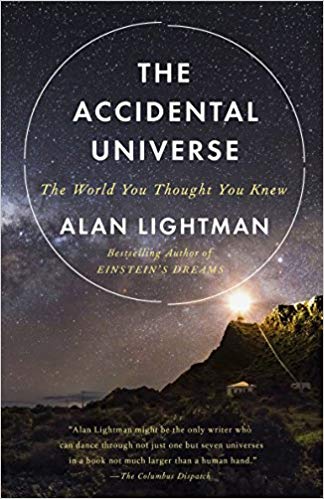
The Accidental Universe: The World You Thought You Knew ~ by Alan Lightman, 2013, philosophy
Lightman explores the emotional and philosophical questions raised by recent discoveries in science.  He looks at the dialogue between science and religion; the conflict between our human desire for permanence and the impermanence of nature; the possibility that our universe is simply an accident; the manner in which modern technology has separated us from direct experience of the world; and our resistance to the view that our bodies and minds can be explained by scientific logic and laws.  Behind all of these considerations is the suggestion--at once haunting and exhilarating--that what we see and understand of the world is only a tiny piece of the extraordinary, perhaps unfathomable whole.
Yearnings: Embracing the Sacred Messiness of Life ~ by Irwin Kula, 2006, religion
Life can be messy and imperfect.  We're all looking for answers, yet the yearning for answers is no different now than it was in the times that gave rise to Moses, Buddha, and Jesus.  Far from being a burden, these yearnings can themselves become a path to blessing, prompting questions and insights, resulting in new ways of being and believing.  Merging ancient wisdom with contemporary insights, Kula shows how traditional practices can enrich our own search for meaning and invites us to embrace the messiness and complexities of our experience as humans in order to fully embrace the endless and glorious project of life.
The Seekers: The Story of Man's Continuing Quest to Understand His World ~ by Daniel J. Boorstin, 1998, cultural history
Boorstin introduces us to some of the pioneering seekers whose faith and thought have for centuries led our search for meaning.  Moses sought truth in God above, while Sophocles looked to reason.  Thomas More and Machiavelli pursued truth through social change.  And in the modern age, Marx and Einstein found meaning in the sciences.  Boorstin follows the great seekers from the heroic age of prophets and philosophers to the present age of skepticism as they grapple with the great questions that have always challenged us.
Theology of Hope ~ by Jürgen Moltmann, 1967 (English), theology
Moltmann reinterprets eschatology as a central Christian Doctrine, seeing it as a starting point for a new understanding of God in history, of Christ and salvation, of the church and its mission. The old hope for the end of time becomes hope in the present reality, a hope opposed to the way things are.  (I bought a second copy because the original was falling apart, but I kept the original because it's the one I annotated when I read it in 1987.)
Misquoting Jesus: The Story Behind Who Changed the Bible and Why ~ by Bart D. Ehrman, 2015, theology
Ehrman reveals that the King James edition of the Bible (1) was based on corrupted and inferior manuscripts that in many cases do not accurately represent the meaning of the original text, (2) the story of Jesus forgiving the woman caught in adultery (John 8:3-11) doesn't belong in the Bible, and (3) scribal errors were so common in antiquity that the author of the Book of Revelation threatened damnation to anyone who adds to or takes away words from the text.  
We Make the Road by Walking: A Year-Long Quest for Spiritual Formation, Reorientation, and Activation ~ by Brian D. McLaren, 2014, religion
Re-imagine what it means to live joyfully and responsibly in today's world as agents of God's justice,creativity, and peace.  These readings give an overview of the whole Bible and guide an individual or a group of friends through a year of rich study, interactive learning, and personal growth.   If you're seeking a fresh way to experience and practice your faith or if you feel out of place in traditional church circles, this book will inspire and activate you in your spiritual journey.
Multiple copies, multiple times

Hmm, I see that I've done this before, and some of the books are the same ones.  I guess I haven't been very prompt in giving away spares.

Monday, January 16, 2017

Jürgen Moltmann ~ theology of hope

Although I haven't finished any of Jürgen Moltmann's books yet in 2017, I've been thinking about HOPE.  For one thing, I chose it for my word of the year, the first time I've ever done such a thing.
And now the picture I've shared above is on my desktop for (at least) this week.  I found it in something posted online about the Women's Marches all across the nation on January 21st, the day after the inauguration.  What are your hopes for this year?

Friday, March 2, 2007

How many of these have YOU read?

Thanks for this bookshelf and this idea to list a hundred books to Stephanie, who got a list from Ms. Literary Feline, who got that list from Bookfool. I had read exactly 50 of the hundred on that list, but I decided to post 100 books that I chose myself. Tell me how many of these you have read:

1. Half of a Yellow Sun ~ by Chimamanda Ngozi Adichie
2. The Measure of All Things ~ by Ken Alder
3. Wouldn't Take Nothing for My Journey Now ~ by Maya Angelou
4. The Battle for God ~ by Karen Armstrong
5. The Clan of the Cave Bear ~ by Jean M. Auel
6. Nothing but the Truth ~ by Avi
7. The Social Construction of Reality ~ by Peter L. Berger
8. Genesis ~ in the Bible (I could claim 66 books)
9. Memories of God ~ by Roberta C. Bondi
10. A Place to Pray ~ by Roberta C. Bondi
11. To Love as God Loves ~ by Roberta C. Bondi
12. The Mists of Avalon ~ by Marion Zimmer Bradley
13. Moloka'i ~ by Alan Brennert
14. Year of Wonders ~ by Geraldine Brooks
15. The Da Vinci Code ~ by Dan Brown
16. The Big Wave ~ by Pearl S. Buck
17. The Good Earth ~ by Pearl S. Buck
18. How the Irish Saved Civilization ~ by Thomas Cahill
19. The Artist's Way ~ by Julia Cameron
20. The Myth of Sisyphus ~ by Albert Camus
21. Our Endangered Values ~ by Jimmy Carter
22. Disgrace ~ by J. M. Coetzee
23. Ireland: A Novel ~ by Frank Delaney
24. The Genesis of Justice ~ by Alan M. Dershowitz
25. The Red Tent ~ by Anita Diamant
26. Great Expectations ~ by Charles Dickens
27. A Tale of Two Cities ~ by Charles Dickens
28. The Brothers Karamazov ~ by Fyodor Dostoevsky
29. The Grand Inquisitor ~ by Fyodor Dostoevsky
30. The River Why ~ by David James Duncan
31. The Breadwinner ~ by Deborah Ellis
32. From Time to Time ~ by Jack Finney
33. Time and Again ~ by Jack Finney
34. Cold Mountain ~ by Charles Frazier
35. Friedman's Fables ~ by Edwin H. Friedman
36. Evensong ~ by Gail Godwin
37. The Good Husband ~ by Gail Godwin
38. Forever ~ by Pete Hamill
39. A Brief History of Time ~ by Stephen Hawking
40. Stranger in a Strange Land ~ by Robert A. Heinlein
41. Catch-22 ~ by Joseph Heller
42. The Old Man and the Sea ~ by Ernest Hemingway
43. Go Out in Joy! ~ by Nina Hermann (reissued, by Nina Hermann Donnelley)
44. Kon-Tiki: Across the Pacific by Raft ~ by Thor Heyerdahl
45. The Kite Runner ~ by Khaled Hosseini
46. Brave New World ~ by Aldous Huxley
47. A Prayer for Owen Meany ~ by John Irving
48. The Dance of the Dissident Daughter ~ by Sue Monk Kidd
49. Secret Life of Bees ~ by Sue Monk Kidd
50. Animal Dreams ~ by Barbara Kingsolver
51. High Tide in Tucson ~ by Barbara Kingsolver
52. The Poisonwood Bible ~ by Barbara Kingsolver
53. Prodigal Summer ~ by Barbara Kingsolver
54. The Fifth Book of Peace ~ by Maxine Hong Kingston
55. English Passengers ~ by Matthew Kneale
56. The View From Saturday ~ by E. L. Konigsburg
57. I Know This Much Is True ~ by Wally Lamb
58. To Kill a Mockingbird ~ by Harper Lee
59. The Altered I ~ by Ursula K. Le Guin
60. The Dispossessed ~ by Ursula K. Le Guin
61. Last Child in the Woods ~ by Richard Louv
62. The Giver ~ by Lois Lowry
63. Number the Stars ~ by Lois Lowry
64. Somewhere in Time ~ by Richard Matheson
65. Teacher Man: A Memoir ~ by Frank McCourt
66. A Canticle for Leibowitz ~ by Walter M. Miller, Jr.
67. A Fine Balance ~ by Rohinton Mistry
68. Humanity in God ~ by Jurgen Moltmann and Elisabeth Moltmann-Wendel
69. Animal Farm ~ by George Orwell
70. 1984 ~ by George Orwell
71. Gnostic Gospels ~ by Elaine Pagels
72. Crack in the Cosmic Egg ~ by Joseph Chilton Pearce
73. Amanda/Miranda ~ by Richard Peck
74. Keeping Faith ~ by Jodi Picoult
75. My Sister's Keeper ~ by Jodi Picoult
76. The Pact: A Love Story ~ by Jodi Picoult
77. Perfect Match ~ by Jodi Picoult
78. Second Glance ~ by Jodi Picoult
79. Songs of the Humpback Whale ~ by Jodi Picoult
80. Vanishing Acts ~ by Jodi Picoult
81. Zen and the Art of Motorcycle Maintenance ~ by Robert M. Pirsig
82. The Chosen ~ by Chaim Potok
83. My Name Is Asher Lev ~ by Chaim Potok
84. Closed Circle: An Interpretation of the Arabs ~ by David Pryce-Jones
85. Ishmael ~ by Daniel Quinn
86. Honest to God ~ by John A. Robinson
87. Lovely Bones ~ by Alice Sebold
88. Snow Flower and the Secret Fan ~ by Lisa See
89. Train to Pakistan ~ by Khushwant Singh
90. Message in a Bottle ~ by Nicholas Sparks
91. The Notebook ~ by Nicholas Sparks
92. Three Weeks with My Brother ~ by Nicholas Sparks and Micah Sparks
93. East of Eden ~ by John Steinbeck
94. Grapes of Wrath ~ by John Steinbeck
95. Of Mice and Men ~ by John Steinbeck
96. The Pearl ~ by John Steinbeck
97. Agape Love ~ by John Templeton
98. Courage to Be ~ by Paul Tillich
99. Tao Te Ching ~ by Lao Tzu, translator Stephen Mitchell
100. Worlds in Collision ~ by Immanuel Velikovsky

Wednesday, August 1, 2012

BOOK REPORT

One book that's been on back order has finally arrived, and another six have arrived or been shipped.

Jesus Wars: How Four Patriarchs, Three Queens, and Two Emperors Decided What Christians Would Believe for the Next 1,500 Years ~ by Philip Jenkins, 2010
The fifth-century political battles that forever changed the church.  In this fascinating account of the surprisingly violent fifth-century church, Jenkins describes how political maneuvers by a handful of powerful characters shaped Christian doctrine.  Were it not for these battles, today's church could be teaching something very different about the nature of Jesus, and the papacy as we know it would never have come into existence.  This book reveals the profound implications of what amounts to an accident of history, that one faction of Roman emperors and militia-wielding bishops defeated another.
With or Without God: Why the Way We Live Is More Important than What We Believe ~ by Gretta Vosper, 2008
Envisioning a future in which the Christian church plays a viable and transformative role in shaping society, Gretta Vosper argues that if the church is to survive at all, the heart of faith must undergo a radical change.  Vosper, a minister in Toronto, believes that what will save the church is am emphasis on just and compassionate living — a new and wholly humanistic approach to religion.  Without this reform, the church as we know it faces extinction.
Worship Come to Its Senses ~ by Don E. Saliers, 1996
What makes Christian worship both true and relevant to ever-changing human circumstances?  How can our gathering about the Scriptures, the Table of the Lord, and the waters of baptism shape and express authentic Christian faith in the world of everyday life?  Saliers finds a fresh way of answering these questions by exploring four "senses" of God:  awe, delight, truth, and hope.  Why are wonderment, surprise, truthfulness, and expectancy so often missing or diminished in Christian liturgy today, whether Protestant or Roman Catholic, "high church" or "low church," "traditional" or "contemporary"?  Saliers contends that we are still restless for communion with God, and suggests how these essentials may be rediscovered by every worshiping congregation.

Proverbs of Ashes: Violence, Redemptive Suffering, and the Search for What Saves Us ~ by Rita Nakashima Brock and Rebecca Ann Parker, 2001
The gap between knowledge born of personal experience and traditional theology led the authors to write this exploration of the doctrine of the atonement.  Using an unusual combination of memoir and theology in the tradition of Augustine's Confessions, they lament the inadequacy of how Christian tradition has interpreted the violence that happened to Jesus.  Ultimately, they argue, the idea that the death of Jesus on the cross saves us reveals a sanctioning of violence at the heart of Christianity.  Brock and Parker draw on a wide array of intimate stories about family violence, the sexual abuse of children, racism, homophobia, and war to reveal how they came to understand the widespread damage being done by this theology.
Saving Paradise: How Christianity Traded Love of This World for Crucifixion and Empire ~ by Rita Nakashima Brock and Rebecca Ann Parker, 2008
When the authors began traveling the Mediterranean world in search of art depicting the dead, crucified Jesus, they discovered that it took Jesus Christ a thousand years to die.  Christians filled their sanctuaries with images of Christ as a living presence in a vibrant world.  He appears as shepherd, teacher, healer, enthroned god, infant, youth, bearded elder, but never dead.  When he appears with the cross, he stands in front of it, serene, resurrected.  But once Jesus perished, dying was virtually all he seemed able to do.  The authors ask how the early vision of beauty evolved into one of torture.  Changes in society and theology marked the medieval emergence of images of Christ crucified.  They found imperial strategies embedded in theologies of redemptive violence, which sheds new light on Christianity's turn to holy war.  They ground justice and peace for humanity in love for the earth and open a new future for Christianity through a theology of redemptive beauty.
The Scandalous Gospel of Jesus: What's So Good about the Good News? ~ by Peter J. Gomes, 2007
"What did Jesus preach?" asks Gomes, who believes that excessive focus on the Bible and doctrines about Jesus have led the Christian church astray.  To recover the transformative power of the gospel — "the good news" — Gomes says we must go beyond the Bible and rediscover how to live out Jesus's original revolutionary message of hope.

Sun of Righteousness, Arise! : God's Future for Humanity and the Earth ~ by Jurgen Moltmann, 2009
Moltmann brings together the biblical, historical, and theological elements of a new integrated Christian vision of the world, especially in light of our contemporary understandings of nature and the evolving universe.  Anchored in the resurrection of Jesus, such a vision affirms that God is the God of resurrection promise, God is present in justice and righteousness, Jesus is the son of righteousness, and nature can be seen as the site of God's work toward the fulfillment of life.  Here is a theological vision that can integrate our faith, inform our worldview, and fuel our life engagements.
AUDIO TAPES

The Only Way : From Cruelty to Compassion through Inner Transformation ~ by Gerald May, 2002 (three audio tapes)

The topic of these tapes fits the subject I'm studying right now (transformed lives that lead toward compassion), so I need to learn more about Gerald May and about Shalem Institute.  To read an excerpt from an article he wrote, click The Only Way : Cruelty to Compassion, Personal Transformation.

Gerald May (1940-2005) was well-known for his writings on psychology and spirituality.  From 1983 to 2005, he served at the Shalem Institute in Washington, DC, as Director of Spiritual Guidance, as Director for Research and Program Development, and finally as Senior Fellow in Contemplative Theology and Psychology.

BLOGGING BREAK

I need a break, but here's something for you to think about while I'm away from the blog.

... and do something about this book mess...

... which has only gotten worse since I took this photo.
(Seven reasons appear at the top part of this blog post.)

Sunday, January 15, 2017

Sunday Salon ~ staying warm and reading

I completed a couple of books this week, both biographical and both about women.

Waking Up White, and Finding Myself in the Story of Race ~ by Debby Irving, 2014, race relations, 10/10
We white people should choose "conver-sation starters that have nothing to do with identifying a person by where they're from, what they do for work, or any other sorting and ranking criteria."  For example (from p. 215):  "So what was the most interesting thing that happened in your day today?"
I Dissent: Ruth Bader Ginsburg Makes Her Mark ~ by Debbie Levy, illustrated by Elizabeth Baddeley, 2016, children's, 9/10
"You could say that Ruth Bader Ginsburg's life has been one disagreement after another. Disagreement with creaky old ideas.  With unfairness.  With Inequality.  Ruth has disagreed, disapproved, and differed.  She has objected.  She has resisted.  She has dissented.  Disagreeable?  NO.  Determined?  YES."
I don't seem to be focusing as much on Jürgen Moltmann's books as I had planned, though I'll catch up.  But I know I also need novels and memoirs in my life.  While working in the Crown Center's small library this week, I picked up a novel by Richard Russo.  And I got two books about Ruth Bader Ginsburg from the University City Public Library, the book for children that I read immediately (above) and the one for adults (shown here).

  • Notorious RBG: The Life and Times of Ruth Bader Ginsburg ~ by Irin Carmon and Shana Knizhnik, 2015, biography
  • That Old Cape Magic ~ by Richard Russo, 2009, fiction (Massachusetts)
Okay, what else happened this week?  Ice happened!  We've had icy roads and sidewalks and trees in St. Louis for the last few days.  I glanced out my window yesterday morning and saw a woman getting up from the sidewalk after a fall.  Most of us are staying inside.  Our schedules changed at the Crown Center when the staff went home in mid-morning on Friday, and I still don't know if we'll have a memorial service today for Marilyn, who died recently.

Bloggers gather in the Sunday Salon — at separate computers in different time zones — to talk about our lives and our reading.

Friday, June 18, 2021

Two book beginnings ~ (1) in a jail cell, and (2) with a question

I usually have both fiction and nonfiction books going at the same time.  I'm re-reading Anna Quindlen's novel One True Thing (1994).  I've recommended it many times, but had forgotten the book's beginning lines:

"Jail is not as bad as you might imagine.  When I say jail, I don't mean prison.  Prison is the kind of place you see in old movies or public television documentaries, those enormous gray places with guard towers at each corner and curly strips of razor wire going round and round like a loop-the-loop atop the high fence."

A mother.  A daughter.  A shattering choice.  Ellen Gulden is enjoying her career as a successful magazine writer in New York City when she learns that her mother, Kate, is dying of cancer.  Ellen’s father insists that she quit her job and return home to become a caregiver.  A high-powered career woman, Ellen has never felt she had much in common with her mother, a homemaker and the heart of their family.  Yet as Ellen begins to spend time with Kate, she discovers many surprising truths, not only about herself, but also about the woman she thought she knew so well.  When Ellen is accused of the mercy killing of her mother, she must not only defend her own life but make a difficult choice — either accept responsibility for an act she did not commit or divulge the name of the person she believes committed a painful act of love.

I'm re-reading Jürgen Moltmann's Experiences of God (1979, English edition, 1980), that I thought I had misplaced.  When I moved my bed away from the wall, I found it had slid down the wall to the floor.  I first read this book in 1988, thirty-three years ago.  Here's the beginning:

"Why am I a Christian?  What a curious question!  Who is interrogating me like this?  Do I have to put my name on my answer?  The question sounds inquisitive.  Somebody wants to know the reasons that led some-body else to a particular conviction.  It sounds impertinent too — as if the other person is bound to justify his decision to believe."

Enduring meditations on hope, anxiety, and mystical experience, together with the author's personal confession of faith.