Showing posts sorted by date for query McLaren. Sort by relevance Show all posts

Tuesday, November 1, 2022

Second Saturday Conversation ~ all things change

Evolution of the word: All things change

This is an online workshop facilitated by Rev. Marianne Borg.  She calls it "Second Saturday Conversation."  I've decided to sign up and also tell you about it, in case you are interested.  Details for this month are below, from her email.  By the way, it's free.

When:  November 12, 2022
Time:  9:30 am - 11:00 am Pacific Time
            Optional "coffee time" 11:05-11:20
Title:  Do I stay Christian?  A conversation with Brian McLaren

Brian McLaren is our guest for Second Saturday Conversation on November 12.  He will bring his experience and reflections to our ongoing exploration of Christianity in and for the 21st century.

Brian is author of over twenty books.  He knows the evangelical world from the inside and outside and the rocky terrain of the Christian landscape in America.  He is also in conversation with people across the globe who hope against hope for a better future.  A better future requires we make changes now.

She mentioned his two most recent books, so here's information about them.  I decided to read this first one after reading an online comment saying it can be summed up in the phrase "The only thing that matters is faith expressing itself through love."  It also contributes to my Nonfiction November challenge to read nonfiction books, which began on October 31st.
Faith After Doubt: Why Your Beliefs Stopped Working and What to Do About it ~ by Brian D. McLaren, 2021, theology, 256 pages

Sixty-five million adults in the U.S. have dropped out of active church attendance and about 2.7 million more are leaving every year.  Faith After Doubt is for the millions of people around the world who feel that their faith is falling apart.  Using his own story and the stories of a diverse group of struggling believers, McLaren (a former pastor and now an author, speaker, and activist) shows how old assumptions are being challenged in nearly every area of human life, not just theology and spirituality.  He proposes a four-stage model of faith development in which questions and doubt are not the enemy of faith, but rather a portal to a more mature and fruitful kind of faith.  The four stages ― Simplicity, Complexity, Perplexity, and Harmony ― offer a path forward that can help sincere and thoughtful people leave behind unnecessary baggage and intensify their commitment to what matters most.
Do I Stay Christian?: A Guide for the Doubters, the Disappointed, and the Disillusioned ~ by Brian D. McLaren, 2022, theology, 272 pages
McLaren addresses in public the powerful question that surprising numbers of people ― including pastors, priests, and other religious leaders ― are asking in private.  Picking up where Faith After Doubt leaves off, Do I Stay Christian? is not McLaren's attempt to persuade Christians to dig in their heels or run for the exit.  Instead, he combines his own experience with that of thousands of people who have confided in him over the years to help readers make a responsible, honest, ethical decision about their religious identity.  There is a way to say both yes and no to the question of staying Christian, McLaren says, by shifting the focus from WHETHER we stay Christian to HOW we stay human.
Here's the rest of Rev. Marianne Borg's email:

All are welcome to Second Saturday Conversation.  There is no registration fee.  An RSVP is required.  Please click on the RSVP link below to register.  The link to the November 12 session will be sent to you the day before and morning of November 12.

Share this announcement.  A way to let people know about Second Saturday Conversation and this special session with author, speaker, pastor, galvanizer, Brian McLaren.

Look forward to seeing you November 12

— Marianne


Knowing we'll be looking at things from Brian McLaren's point of view, I looked to see which of his books are on my bookshelves or on the Kindles (mine and Donna's that I inherited).  Here's what I found there and on this blog:

Way of Life: Participant Guide ~ guide by Maria Mayo (for the 2016 book The Great Spiritual Migration by Brian D. McLaren), 2017, study guide, 80 pages, 9/10

This participant guide provides an introduction to the main text and can also stand alone with additional commentary and questions.  The book also contains new content from McLaren, including personal devotionals he wrote for each section.  I rated it 9 of 10.

In The Great Spiritual Migration: How the World's Largest Religion Is Seeking a Better Way to Be Christian (288 pages, 2016), McLaren argues that for Christianity to survive, it must shift away from an outdated system of beliefs to a way of life based on love.  In order to achieve this, McLaren outlines three migrations:

1.  Spiritually, Christians focus less on doctrine and more on the abiding life of love made manifest in Jesus.
2.  Theologically, a new way of reading Scripture shifts away from literalism and toward a more generous, literary approach.
3.  Missionally, the new way of life leads to "organizing religion" rather than organized religion, in which spiritual activists are committed to ecological, economic, and interfaith concerns.

Naked Spirituality: A Life with God in 12 Simple Words ~ by Brian D. McLaren, 2011, theology, 280 pages

McLaren presents a four-stage framework for understanding the spiritual life, and he unfolds spiritual practices appropriate to each stage.  Each practice is rooted in a simple word:  here, thanks, O, sorry, help, please, when, no, why, behold, yes, and silence.  I noted these lines when I read this book:

"Contemplating a loving God strengthens portions of our brain — particularly the frontal lobes and the anterior cingulate — where empathy and reason reside.  Contemplating a wrathful God empowers the limbic system, which is 'filled with aggression and fear.'  It is a sobering concept:  The God we choose to love changes us into his image, whether he exists or not" (p. 71).

McLaren was quoting Michael Gerson's summary of a different book, but it is a very interesting thought, isn't it?

We Make The Road By Walking: A Year-Long Quest for Spiritual Formation, Reorientation, and Activation ~ by Brian D. McLaren, 2014, theology, 304 pages

The fifty-two (plus a few) weekly readings can each be read aloud in 10 to 12 minutes and offer a simple curriculum of insightful reflections and transformative practices.  These readings give an overview of the whole Bible and guide an individual or a group of friends through a year of study, interactive learning, and personal growth.

Just looking at what I underlined eight years ago reminds me of how much I like Brian McLaren's writing.  I'm ready to finish reading this book and (hopefully) the one below:

Seeking Aliveness: Daily Reflections on a New Way to Experience and Practice the Christian Faith
~ by Brian D. McLaren, 2017, devotional, 400 pages

This is a 52-week devotional, based on his book We Make The Road By Walking (see above) to inspire and activate you in your spiritual journey.  Here you'll find a reorientation from a fresh and healthy perspective to explore what a difference an honest, living, growing faith can make in your life and in our world today.

This book is on Donna's Kindle, and she rated it 5 stars out of 5.  She highlighted some sections, so it will be almost like discussing it with her.

Tuesday, March 24, 2020

Two by two

I've been decluttering (one good thing about being told to stay home), and I've found several books I've bought twice.  Have you ever done that?  For the first one, I can at least claim that the books LOOK so very different that I didn't recognize it.  The "extra" books have been going to my BFF Donna, if she wants them.  Yearnings was probably meant for her in the beginning, since I posted on this blog that I bought one "for a friend (one I already have, so we could study it together)"  Here are my duplicates (so far):

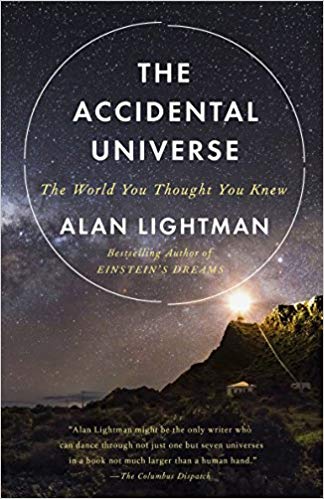
The Accidental Universe: The World You Thought You Knew ~ by Alan Lightman, 2013, philosophy
Lightman explores the emotional and philosophical questions raised by recent discoveries in science.  He looks at the dialogue between science and religion; the conflict between our human desire for permanence and the impermanence of nature; the possibility that our universe is simply an accident; the manner in which modern technology has separated us from direct experience of the world; and our resistance to the view that our bodies and minds can be explained by scientific logic and laws.  Behind all of these considerations is the suggestion--at once haunting and exhilarating--that what we see and understand of the world is only a tiny piece of the extraordinary, perhaps unfathomable whole.
Yearnings: Embracing the Sacred Messiness of Life ~ by Irwin Kula, 2006, religion
Life can be messy and imperfect.  We're all looking for answers, yet the yearning for answers is no different now than it was in the times that gave rise to Moses, Buddha, and Jesus.  Far from being a burden, these yearnings can themselves become a path to blessing, prompting questions and insights, resulting in new ways of being and believing.  Merging ancient wisdom with contemporary insights, Kula shows how traditional practices can enrich our own search for meaning and invites us to embrace the messiness and complexities of our experience as humans in order to fully embrace the endless and glorious project of life.
The Seekers: The Story of Man's Continuing Quest to Understand His World ~ by Daniel J. Boorstin, 1998, cultural history
Boorstin introduces us to some of the pioneering seekers whose faith and thought have for centuries led our search for meaning.  Moses sought truth in God above, while Sophocles looked to reason.  Thomas More and Machiavelli pursued truth through social change.  And in the modern age, Marx and Einstein found meaning in the sciences.  Boorstin follows the great seekers from the heroic age of prophets and philosophers to the present age of skepticism as they grapple with the great questions that have always challenged us.
Theology of Hope ~ by Jürgen Moltmann, 1967 (English), theology
Moltmann reinterprets eschatology as a central Christian Doctrine, seeing it as a starting point for a new understanding of God in history, of Christ and salvation, of the church and its mission. The old hope for the end of time becomes hope in the present reality, a hope opposed to the way things are.  (I bought a second copy because the original was falling apart, but I kept the original because it's the one I annotated when I read it in 1987.)
Misquoting Jesus: The Story Behind Who Changed the Bible and Why ~ by Bart D. Ehrman, 2015, theology
Ehrman reveals that the King James edition of the Bible (1) was based on corrupted and inferior manuscripts that in many cases do not accurately represent the meaning of the original text, (2) the story of Jesus forgiving the woman caught in adultery (John 8:3-11) doesn't belong in the Bible, and (3) scribal errors were so common in antiquity that the author of the Book of Revelation threatened damnation to anyone who adds to or takes away words from the text.  
We Make the Road by Walking: A Year-Long Quest for Spiritual Formation, Reorientation, and Activation ~ by Brian D. McLaren, 2014, religion
Re-imagine what it means to live joyfully and responsibly in today's world as agents of God's justice,creativity, and peace.  These readings give an overview of the whole Bible and guide an individual or a group of friends through a year of rich study, interactive learning, and personal growth.   If you're seeking a fresh way to experience and practice your faith or if you feel out of place in traditional church circles, this book will inspire and activate you in your spiritual journey.
Multiple copies, multiple times

Hmm, I see that I've done this before, and some of the books are the same ones.  I guess I haven't been very prompt in giving away spares.

Thursday, August 17, 2017

Another bagful of books

I wrote about two bags full of books from the JCC used book sale in 2015 and about one very, very full bag of books from their sale in February.  I've done it again.  May I blame Marilyn?  She asked for a ride to the JCC because this is the last day, when we get a whole bagful of books for a flat $5.  We took Donna along with us and, honestly, didn't stay long.  And still I came home with these 15  books.
1.  To Life! : A Celebration of Jewish Being and Thinking ~ by Harold S. Kushner, 1993
2.  How Good Do We Have to Be? : A New Understanding of Guilt and Forgiveness ~ by Harold S. Kushner, 1996
3.  The Liturgical Year: The Spiraling Adventure of the Spiritual Life ~ by Joan Chittister, 2009
4.  Pastrix: The Cranky, Beautiful Faith of a Sinner and Saint ~ by Nadia Bolz-Weber, 2013
5.  Quantum Healing: Exploring the Frontiers of Mind/Body Medicine ~ by Depak Chopra, 1989
6.  Finding Our Way Again: The Return of the Ancient Practices ~ by Brian McLaren, 2008
7.  Rambam's Ladder: A Meditation on Generosity and Why It Is Necessary to Give ~ by Julie Salamon, 2003
8.  God's To-Do List: 103 Ways to Be an Angel and Do God's Work on Earth ~ by Dr. Ron Wolfson, 2007
9.  Reading the Bible Again for the First Time: Taking the Bible Seriously but Not Literally ~ by Marcus J. Borg, 2001
10.  Heidegger and a Hippo Walk Through Those Pearly Gates: Using Philosophy (and Jokes!) to Explore Life, Death, the Afterlife, and Everything in Between ~ by Thomas Cathcart and Daniel Klein, 2009
11.  Take This Bread: A Radical Conversion ~ by Sara Miles, 2007
12.  The Land and the Book: An Introduction to the World of the Bible ~ by Charles R. Page II and Carl A. Volz, 1993
13.  The Message//REMIX: Solo: An Uncommon Devotional ~ text by Eugene H. Peterson, devotional content by Jan Johnson, J. R. Briggs, and Kate Peckham, 2007
14.  Does God Have a Big Toe? : Stories About Stories In the Bible ~ by Marc Gellman, illustrated by Oscar de Mejo, 1989
15.  Cultural Literacy: What Every American Needs to Know ~ by E. D. Hirsch, Jr., 1987
I guess it's obvious I browsed only among the books in the section on philosophy, religion, theology, and psychology, right?  Among those books was one entitled Talking God by Tony Hillerman (1989).  Having worked in a library and owned a bookstore, I recognized it as fiction:
Talking God is the ninth crime fiction novel in the Joe Leaphorn / Jim Chee Navajo Tribal Police series by Tony Hillerman published in 1989.
Tony Hillerman is a novelist, not a theologian.  I moved their book to the correct table.

Thursday, February 4, 2016

BTT ~ multiple copies

Today's prompt from BTT:
"Do you own multiple copies of any books?  Why?  Is it the format?  Size?  Just because you love it?"
I have multiple reasons for getting multiple books.

First, to replace one that's practically unreadable because it's falling apart.  On my last day at seminary (April 24, 1987), I went to the bookstore and bought Theology of Hope by Jürgen Moltmann, happy I'd finally have time to read it instead of assigned homework.  I underlined and wrote in the margins as I read the book, but the pages began to fall out of the browning cover as the glue dried out.  The first 78 pages are in one clump, and pages 79-156 are another clump.  The cover is still holding onto pages 157-342, with a huge gap in the front.  I could have thrown it away, but my notes are all through that copy.  After 25 years, I bought a new copy in 2012.  This shiny version, I'm happy to report, has a notice on the copyright page promising it won't turn all brown like the first one:
"The paper used in this publication meets the minimum requirements of American National Standard for Information Sciences-Permanence of Paper for Printed Library Materials."
Second, I have multiple copies of books I use in classes I teach.  For example, I still have four brand-new copies of The Complete Gospels edited by Robert J. Miller, as well as my own well-marked and tabbed copy.  If and when I teach my class on "Seven Gospels," I'll sell those copies — probably for less than I originally paid for the books, but at least it will free up some shelf space for other books.

Third, I have been known to buy a copy of a book and get home to discover I have one already on my shelves.  Sometimes, they are different editions and, thus, don't look the same.  Usually, I simply gave one of them to my friend Donna so we can both read and discuss it.

Fourth, which is related to the third reason, I unknowingly bought a second copy of Misquoting Jesus: The Story Behind Who Changed the Bible and Why by Bart D. Ehrman, but have NOT given away either version.  Both were published by HarperSanFrancisco, but one has "Plus" in the back:
Questions and answers with the author
Readers' responses to the book
Famous manuscripts
Top ten verses that were not originally in the New Testamant
Unfortunately, though this one appears to be the newer one, it has browner pages and a cut-out oval on the front cover that will probably tear at some point (cover on the right).  The other (on the left) has whiter pages and slightly larger print, making it easier to read.

Fifth, I have a extra copy of We Make the Road by Walking by Brian D. McLaren because a friend decided not to join me and others in our year-long quest for spiritual formation as we studied the book.  I'll probably give it away.

You may have noticed all these examples are nonfiction.  I'm not likely to buy two novels, since I rarely buy fiction at all.  I'll let the library provide those for me.

Friday, August 29, 2014

Friday Five ~ five things that are new in my life

Mary Beth brings us today's Friday Five:
"So, no matter what the weather’s doing where you live, this time of year brings the beginning of school for most people.  Unless you are in year round school, or homeschooling, or something else.  Many folks I know say the beginning of school makes them feel like a new beginning, even if they are not in school themselves or have kids there.  In fact, I did a little math at the beginning of the week and determined that, based on my career in higher education and when I entered first grade, I am entering the 44th Grade this year.  So, for beginnings:  Tell us five things that are new in your life, or that you would LIKE to have be new in your life.  If that doesn’t work, how about things that you are ready to shed ... to make room for new things?  Opening your hands to release, to see what God might put into them?  So, go!"
Five things that are new in my life:

1.  New home
In June, I moved to St. Louis from my hometown of Chattanooga, Tennessee.  It's been a great adventure so far, as I settle into my new home and ... (ta-da!) ... make new friends!
2.  New friends
Evelyn, Betty, Sheila, Judy, Tomoko, Nancy, and Marilyn eat at my table at our "senior living" apartments.  I've attended all sorts of activities so I'd get to know my new neighbors in the building.  I've taken road trips with them and gone to all three "birthday bashes" in the three months I've lived here.  And I've participated in resident council meetings.  We didn't have anything like that where I used to live.  These people are very active and involved, and I'm loving it!
3.  New study buddies
My way of continuing to learn and "be in school" is to gather a group of my new friends — and one old friend — into a book discussion and "teach" each other.  We are currently studying Brian McLaren's 2014 book We Make the Road by Walking: A Year-Long Quest for Spiritual Formation,Reorientation, and Activation.
4.  New stole
Because I'm in St. Louis and live only six or eight miles from Ferguson, I learned on the 20th of a call for clergy in vestments to gather in solidarity for prayer and witness.  Local and statewide clergy would march to the county's Justice Center for a brief demonstration and prayer, and then the group would "caravan to Ferguson and consecrate the area with prayer and oil" so that our presence, prayers, and prophetic witness would make a difference.  Oops!  I just moved.  I had kept one stole when I retired, a tapestry stole showing children of the world, but which box was it in?  I got the invitation the day of the gathering and I didn't have time to search through boxes, so I went out and bought a new stole.  It's tapestry, similar in color to the one of the children that I have, somewhere, not yet unpacked.  And I did get it in time to march with the others, wearing my new clergy stole.
5.  New church
When I moved into my new home, in a new state, hundreds of miles from my last church, I set out to find a new church home.  University United Methodist Church is only two and a half miles from home, has a clergywoman as new to St. Louis as I am, and (as an added plus) both she and her husband graduated from Candler School of Theology at Emory University in Atlanta -- just as I did.  He teaches at Eden Seminary.  The Rev. Diane Kenaston is wearing the white robe and stole in the top photo, and her husband Adam Ployd is the bearded man behind her.  I was there, but only my left hand made it into the photo.  I was just to the left of the picture, beside the man wearing the white shirt.

Sunday, August 3, 2014

Sunday Salon ~ my friend, the author

BOOKS
St. Louis: Yesterday and Today ~ by Betty Burnett, 2009, history
This author was a new friend before I realized she had published several books.  I met Betty in my new face-to-face book club in June, had lunch with her recently, and was delighted when she joined my discussion group that's studying We Make the Road by Walking: A Year-Long Quest for Spiritual Formation, Reorientation, and Activation by Brian D. McLaren (2014).  I checked out one of Betty's glossy, coffee table books from the library and have been learning more about my new town.
Selected Writings of Bahá'u'lláh ~ translated by Shoghi Effendi, 1979, religion
My copy looks similar to this one, but it's apparently older than any cover photos Google can find.  I found this book at McKay's in Chattanooga shortly before moving, and bought it because I've never studied the religion in depth even though I taught religions of the world for years as an adjunct at Chattanooga State.  I took it off the shelf and started reading when Betty Burnett mentioned one of the residents here in our apartment building is of the Bahá'í faith.  I love the diversity among my new neighbors!
When Children Ask About God: A Guide for Parents Who Don't Always Have All the Answers ~ by Harold S. Kushner, 1989, religion
My new friend Sheila brought me a book to read that she thinks I'd like.  I'm sure I will, since I've read nearly everything Harold Kushner has written, including When Bad Things Happen to Good People (1981).  This week, I found out Sheila has written the lyrics for several musicals, including one that is being revived in St. Louis this year.  I hope it works out that I'll be able to attend.
Goodnight June ~ by Sarah Jio, 2014, fiction (Seattle, Washington), 10/10
I finished this novel in a couple of days and rated it a 10 out of 10 because I couldn't put it down.  On Friday, I wrote about the book's first lines, if you want to read more about it.  I highly recommend it, especially if you enjoyed the beloved children's book Goodnight Moon by Margaret Wise Brown.  The author imagines a bookstore owner who was "Brownie's" friend and the inspiration for her moon book.

FAMILY NEWS

My granddaughter has announced that the twins she's expecting are boys.  I had never heard of a "gender reveal" party, but it must be a thing these days.  Their cake was half pink and half blue, but only cutting into it "revealed" blue circles that were baked inside.

Bloggers gather in the Sunday Salon — at separate computers in different time zones — to talk about our lives and our reading.

Sunday, June 29, 2014

Sunday Salon ~ moving takes time

The two windows in the center, just above the tree (and the van/bus) are mine.  Count down from the tenth floor (10-9-8-7-6) to my windows on the corner of the sixth floor.  On the left is my bedroom, on the right is my living room, and my kitchen window is around the corner, facing the street, but hidden in the indented part of the building.  I overlook the connecting portion between the two buildings of the Crown Center.

I finally have wi-fi in my new apartment, so I can get back to blogging now!  I'm still unpacking boxes, of course, but it looks like home now.  It's almost July, and the weeks of June have been filled with unpacking, one box after another.  Eventually, I'll show you more of my new place than the windows above the trees.

BOOKS

New books — yes, I can see it may not be a good thing that Barnes and Noble is only a block away.  And because it's just across the parking lot from my new grocery store, I can't really avoid it, can I?  Of course not!

We Make the Road by Walking: A Year-Long Quest for Spiritual Formation, Reorientation, and Activation ~ by Brian D. McLaren, 2014
Explore what a difference an honest, living, growing faith can make in our world today, and create a life-changing learning community.  The readings offer insightful reflections and transformative practices to guide an individual or a group of friends through a year of interactive learning and personal growth.
The Voice Bible ~ published by Thomas Nelson, 2012
This is a faithful dynamic equivalent translation that reads like a story.  It invites readers to enter into the whole story.  It recaptures the passion, grit, humor, and beauty that is often lost in the translation process.  The result is a retelling of the story of the Bible in a form as fluid as modern literary works, while remaining painstakingly true to the original manuscripts.
Bloggers gather in the Sunday Salon — at separate computers in different time zones — to talk about our lives and our reading.

Sunday, December 30, 2012

Sunday Salon ~ booked up

REAL LIFE

VISITORS

Tillie and Donna represent all the people who have cheered me on as I recuperate from falling and shattering my shoulder on December 6th.
  • My roommate Donna has been my biggest helper:  making meals, doing my laundry, helping me dress, waking from a sound sleep when I call for help, getting me to appointments, shopping for things I need, bringing home library books.
    One-handed (left hand, at that), I cannot cut a piece of meat, peel a banana, open a can, tear open a microwave box, stir food cooking on the stove, slice an apple, open a plastic bag, tear open a granola bar, or pop the top of a little can of V-8.  I have managed to cut open a small packet using scissors, but only when I can keep it from sliding away from me.
  • My daughter Sandra, who saw the ambulance pull away from the restaurant where I fell, came to the ER as soon as she was notified and has spent lots of time with me, taking me to doctors, running errands for me, and makimg my apartment more accessible for me in my newly handicapped condition.
  • Jane, Larry and Betty, June, Jeannine, Irby and Sara, Ginnie, Phil, Linda and Gene, Elsa and Bob, Martha, Sandra, Tillie, Charlotte, Bill and Diane, and many others from my church and Sunday school have brought food.  (Jane also brought a "reacher" and an expandable back-scratcher.)
  • Ginnie, Emily, Sandra, and Jane each stayed with me when Donna was at work or volunteering at the Community Kitchen for the homeless or at her own medical appointments.
  • Some, like my neighbor Anthony and Phil (who sent this email), were willing to help in other ways.
    "Bonnie, glad to know that your mind and left arm are both functioning enough to send an e-mail.  I have been following your condition through Jane's notes.  I do not cook, but will be glad to pick up items you need from the grocery.  I do drive and will be glad to take you to the doctors or other places needed.  I am in town for next several weeks except for week-end of December 14, 15 and 16.  Give me a call any time."
  • Many others sent cards by snail mail or left messages here on my posts or emailed me.
  • Home health care folks take care of sponge baths and — just yesterday — shampooing my hair.
Yes, it takes a village, and I am so grateful to every single one of you.  I feel blessed.

This is my 2-year-old great-grandson Jaxon, showing us that he knows how a cane is to be used.  It's a tad large for him though, don't you think?

WHITE-TAILED DEER

Every Saturday morning, beginning precisely at 7:30 a.m., we hear rifle shots nearby.  Every Saturday, including yesterday morning.  I wonder how many of these white-tailed deer have been killed since I wrote about them a month ago.  (Click the photo once or even twice to enlarge it and see the nine deer running away when I appeared.)

PLAYING CATCH UP

I started studying several books this year that, for one reason or another, I never completed.  If I have a New Year's resolution, it's to finish working my way through these books.

Christianity for the Rest of Us: How the Neighborhood Church Is Transforming the Faith ~ by Diana Butler Bass, 2006

Living Buddha, Living Christ ~ by Thích Nhất Hạnh, introduction by Elaine Pagels, Foreward by Brother David Steindl-Rast, 1995, religion

Naked Spirituality ~ by Brian D. McLaren, 2011

JUST ARRIVED

Donna's pastor handed her his copy of this book, saying he thought she would like it.  She did, telling me one of us ought to buy a copy so she could read it again someday.  So I ordered it and have now started reading my copy.  I've read more than 50 pages of it and agree totally that this is a book Donna and I will want to discuss.

Jim and Casper Go to Church ~ by Jim Henderson and Matt Casper, 2007, religion
Jim Henderson pays people to go to church.  In fact, he made national news when he “rented” a soul for $504 on E-Bay after its owner offered an “open mind” to the highest bidder.  In this book, Hendrson hires another atheist — Matt Casper — to visit ten leading churches with him and give the “first impression” perspective of a non-believer.  What follows is a startling dialogue between an atheist and a believer seeing church anew through the eyes of a skeptic — and the development of an amazing relationship between two men with diametrically opposing views of the world who agree to respect each others' space.
 Visit the Sunday Salon's Facebook page for links to more posts.

Sunday, September 16, 2012

Sunday Salon ~ seminar by Diana Butler Bass

Diana Butler Bass, after yesterday's sessions
Diana Butler Bass led a weekend seminar about Christianity After Religion, her latest book.  In July, I discussed the book and Butler Bass's three B's:  believing, behaving, and belonging.
Believing ~ What do I think?
Behaving ~ How should I act?
Behaving ~ What do I do?
Belonging ~ Who am I?
My friend Donna and I attended all three sessions on Friday and Saturday and plan to hear Butler Bass again this morning as she teaches a Sunday school class and preaches a sermon at the church which hosted the seminar.  I have a lot to tell you about what I've learned.

BOOKS

One book arrived this week via UPS.
Why Did Jesus, Moses, the Buddha, and Mohammed Cross the Road?: Christian Identity in a Multi-Faith World ~ by Brian McLaren, 2012

When four religious leaders walk across the road, it's not the beginning of a joke.  It's the start of one of the most important conversations in today's world.  Can you be a committed Christian without having to condemn or convert people of other faiths?  Is it possible to affirm other religious traditions without watering down your own?  Brian McLaren proposes a new faith alternative, one built on "benevolence and solidarity rather than rivalry and hostility."  This way of being Christian is strong but doesn't strong-arm anyone, going beyond mere tolerance to vigorous hospitality toward, interest in, and collaboration with the other.  McLaren shows step-by-step how to reclaim this strong-benevolent faith, challenging us to stop creating barriers in the name of God and learn how affirming other religions can strengthen our commitment to our own.  And in doing so, he invites Christians to become more Christ-like than ever before.
One book arrived because Donna and I attended the author's seminar and bought it to get it signed.
Christianity for the Rest of Us: How the Neighborhood Church Is Transforming the Faith ~ by Diana Butler Bass, 2006

For decades the accepted wisdom has been that America's mainline Protestant churches are in decline, eclipsed by evangelical mega-churches.  Church and religion expert Diana Butler Bass wondered if this was true, and this book is the result of her extensive, three-year study of centrist and progressive churches across the country.  Her surprising findings reveal just the opposite — that many of the churches are flourishing, and they are doing so without resorting to mimicking the mega-church, evangelical style.  Butler Bass describes this phenomenon and offers a how-to approach for Protestants eager to remain faithful to their tradition while becoming a vital spiritual community.  As she delved into the rich spiritual life of various Episcopal, United Methodist, Disciples of Christ, Presbyterian, United Church of Christ, and Lutheran churches, certain consistent practices — such as hospitality, contemplation, diversity, justice, discernment, and worship — emerged as core expressions of congregations seeking to rediscover authentic Christian faith and witness today.  This hopeful book reveals the practical steps that leaders and laypeople alike are taking to proclaim an alternative message about an emerging Christianity that strives for greater spiritual depth and proactively engages the needs of the world.
What have you been reading?

Visit the Sunday Salon's Facebook page for links to more posts.

Sunday, July 29, 2012

Sunday Salon ~ about those books

WHAT I'VE BEEN READING

"Which of the beatitudes in the Sermon on the Mount says, 'Blessed are the theologically sound, for they shall be smug'?"
— Robin Meyers, The Underground Church, p. 8

"If the church were Christian, gracious behavior would be more important than right belief."
— Philip Gulley, If the Church Were Christian, p. 67

"I am not in the least accusing of dishonesty those who find the traditional framework of metaphysics and morals entirely acceptable. ... What dismays me is the vehemence — and at bottom the insecurity — of those who feel that the Faith can only be defended by branding as enemies within the camp those who do not."
— John A. T. Robinson, Honest to God, p. 9

"When we project qualities of the post-Easter Jesus back onto the pre-Easter Jesus, we make the pre-Easter Jesus not one of us."
— Marcus J. Borg, Embracing an Adult Faith, p. 26

"Contemplating a loving God strengthens portions of our brain — particularly the frontal lobes and the anterior cingulate — where empathy and reason reside. Contemplating a wrathful God empowers the limbic system, which is 'filled with aggression and fear.' It is a sobering concept: The God we choose to love changes us into his image, whether he exists or not."
— Andrew Newberg and Mark Robert Waldman,
How God Changes Your Brain,
quoted in Naked Spirituality by Brian D. McLaren, p. 71

Visit the Sunday Salon's Facebook page for links to more posts.