
Tuesday, September 4, 2012

Sunday, September 2, 2012
Top ten most read books

1. The BiblePrinted in white and difficult to read:
2. Quotations from Chairman Mao Tse-Tung
3. Harry Potter
4. The Lord of the Rings
5. The Alchemist
6. The Da Vinci Code
7. The Twilight Saga
8. Gone with the Wind
9. Think and Grow Rich
10. The Diary of Anne Frank
"Based on number of books printed and sold over the last 50 years. Some titles may have had more copies printed than some of these books, but a vast number of those books were not sold, so we'll assume that they did not get read."
Sunday, August 26, 2012
Does the church have a future?

"If there is a future for the church in America, perhaps it is to raise America's collective consciousness, so that injustice, poverty, and tyranny would be moral affronts to us and we would hasten to eliminate them. Such a church would creatively and consistently call us to heed our better angels. It would actively engage our leaders, urge gracious treatment for the poor and powerless, promote peace and reconciliation among nations, challenge abusive religion, and provide a setting where people could reflect upon significant matters. The central task of this church would not be convincing us to believe doctrines about Jesus. Rather, it would help us live out the priorities of Jesus — human dignity, spiritual growth, moral evolution, and the ongoing search for truth and meaning."If the Church Were Christian: Rediscovering the Values of Jesus ~ by Philip Gulley, 2010, religion, 9/10
Friday, August 24, 2012
If the Church Were Christian ~ by Philip Gulley

Consider this: Jesus offered no new revelation from God. Everything he said and did grew out of his Jewish faith. As in all religions, there were those in Judaism who'd forgotten and forsaken its principles. What first-century Judaism needed wasn't a new revelation, but the reminder of a previous one. The prophets preceding Jesus had described well the priorities of God — mercy, forgiveness, hospitality, and compassion. Jesus exemplified those virtues, expanded their meaning for his generation, and through the power of his good example, urged others to not only imitate his works, but to exceed them.These three paragraphs are from pages 25-26 of the first chapter, entitled "If the church were Christian ... Jesus would be a model for living rather than an object of worship."
What Jesus wasn't about was his own glorification and elevation. Rather, he argued for humility, modesty, and putting others before self. This was not a man claiming a special status for himself, but a man committed to faithfully living out the priorities of God's reign and helping others do the same. Being a fitting example was precisely what he was about. Instead of accepting that, the church made Jesus God, interpreting his life in ways he likely didn't intend, convincing itself that his way of living was only possible because he was God, providing humanity an excuse not to be like him. In my twenty-five years of pastoral ministry, I have heard people say time and again, "I could never be like Jesus." But what I've discovered in the Gospels is the expectation that we could and should be like him.
The Christian gospel ought not be that Jesus was God and we can find life in his death. Our good news is that we can find life in his example — accepting the excluded, healing the sick, strengthening the weak, loving the despised, and challenging the powerful to use their influence redemptively. These objectives do not require divinity, but commitment, compassion, and courage. Jesus accomplished what he did not because of some supernatural power unavailable to the rest of us; he accomplished what he did because of his steadfast dedication to the priorities of God.
Monday, August 13, 2012
Proverbs of Ashes ~ Rita's story
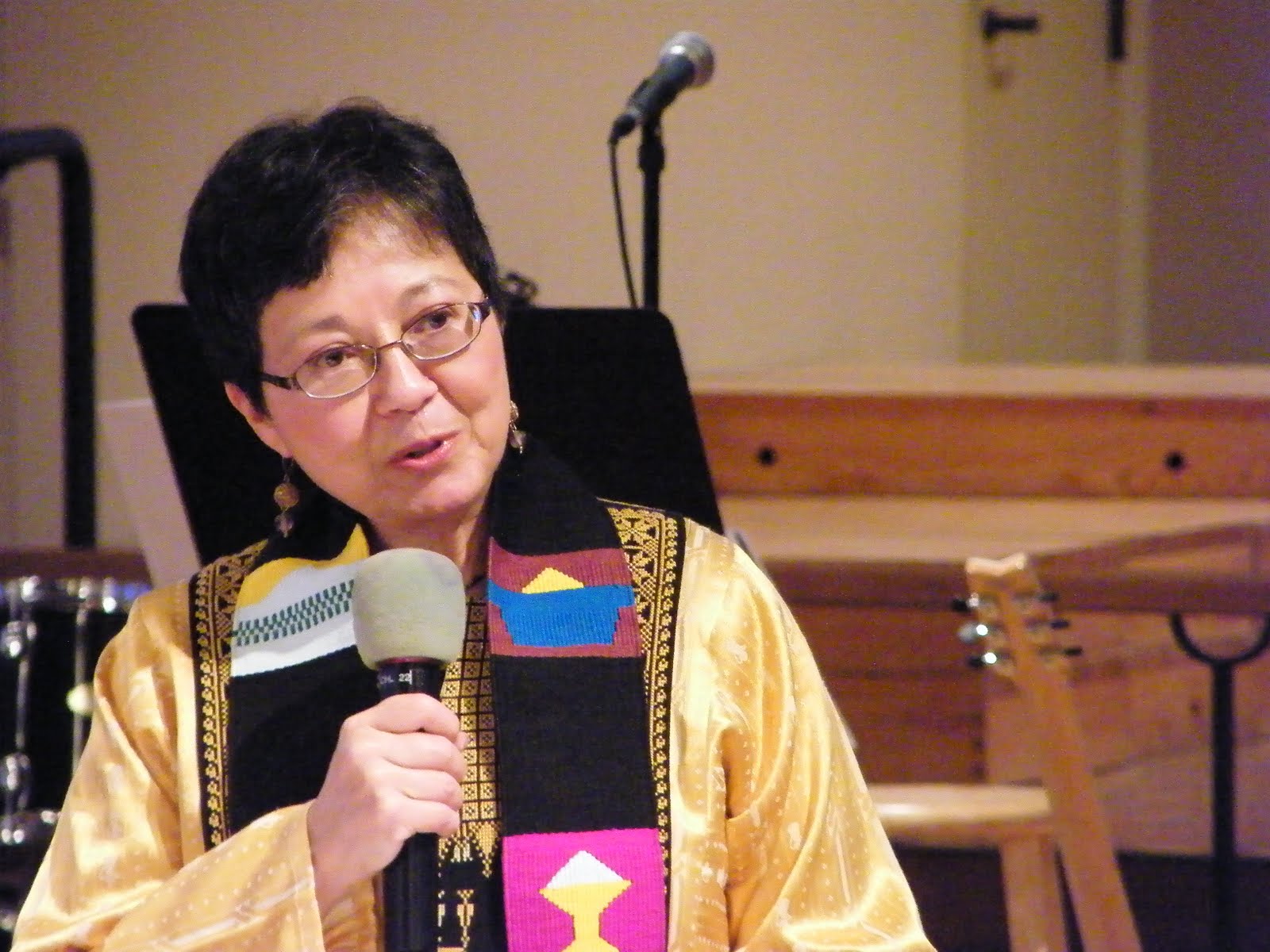
Rita and Rebecca take turns sharing their stories in this combination of memoir and theology. Rebecca writes about growing up half Japanese in American — she was born in Japan to a Japanese mother and a U.S. soldier. She explores the two cultures on pages 81-82.
Japanese culture values harmony in relationships and kinship. Being individualistic or self-assertive was seen as pathological in my Japanese home, which valued humility and generosity. Respectful behavior showed one belonged. Whether one actually believed personally in ancestor spirits was less relevant than participating in rituals that demonstrated one's gratitude and respect for those who have passed on.Rita, who the author of the award-winning Journeys by Heart, is a research associate at Starr King School for the Ministry at the Graduate Theological Union in Berkeley, California.
The Western version of Buddhism emphasized personal meditation practices, rather than adoption of its Asian cultural forms. European American Buddhism tends to ignore kinship networks, formal ritual, and obligation to family members, living and dead. North American Buddhism prefers to focus on individual spirituality and / abstract values such as "respect for nature," or "enlightenment," as a means to help practitioners transcend themselves, their families, and their community obligations. Christianity functions in a similar way in Asia as Buddhism functions in the United States Converts to Christianity use it to transcend the limitations of family and culture. When religious ideas get separated from their cultural forms, they take on different meanings. They move against a society's norms and grant people more individual freedom.
The values of my American life have often been at odds with my Japanese origins. The anti-religious spiritual search so characteristic of Americans is part of my Protestant upbringing. Protestant Christianity places above all else the relationship of the individual self to God, and U.S. society reflects this with its emphasis on indivual achievement, self-assertion, authenticity, and personal fulfillment. The search for individual fulfillment is often based on an antagonism toward organized forms of religion — toward forms of religion that are social and community-based. ... I needed a way of being religious that connected me to others, that broke through my isolation, that gave me living presence. Denver's life had done that, but not his theology. [Denver was a Baptist preacher and father figure for Rita.]

(Rebecca's story, Aug 12, 2012)
Sunday, August 12, 2012
Proverbs of Ashes ~ by Rita Nakashima Brock and Rebecca Ann Parker
 |
| Rebecca Ann Parker |
Rebecca and Rita take turns sharing their stories in this combination of memoir and theology. Rebecca tells this story (on page 34) about her father, who was a Methodist minister.
When I was twelve, we had confirmation class, and my father was our teacher. Just before Palm Sunday, each child was invited to decide whether or not to join the church. I'd thought about it carefully and announced to my father that I was not going to join. My mother had already sewn me a spring-yellow Easter dress to wear for the confirmation service, but I ignored this fact. Nor did I consider that my father might be embarrassed if his own daughter decided to remain a heathen.Rebecca is now an ordained United Methodist minister in dual fellowship with the Unitarian Universalist Association. She is also professor of theology at Starr King School for the Ministry at the Graduate Theological Union.
My father, however, did not show the slightest sign of unhappiness with me. He respectfully said, "You have a perfect right not to join the church. But I would be interested to hear your reasons."
I explained myself. "First of all, I don't believe that God sends people to hell." Nothing in my liberal Methodist upbringing had asserted that God condemned people to hell, but I'd gotten the idea somewhere, and I objected to it. "If there is a God," I continued, "God must be at least as good as you and Mother. Neither of you would ever condemn anyone to eternal damnation." My father nodded, appreciatively.
"Furthermore," I went on, "I don't believe that Jesus was the only son of God. I believe everyone is a child of God."
My father said, "Do you know what a person who believes as you believe is called?" "No," I said, surprised to hear that there was a name for my heresy.
"A Unitarian," my father said. Then he added, "I'm a Unitarian in my theology. I agree with your ideas. You can be a Unitarian and join the United Methodist Church. There is freedom to believe as you see fit. John Wesley, the founder of Methodism, frequently preached on the maxim, 'We need not all think alike to love alike.'"
"Oh!" I said, happy to discover this. "Then I'll join the church."

(Rita's story, Aug 13, 2012)
Subscribe to:
Posts (Atom)