Showing posts with label world religion challenge. Show all posts

Thursday, December 30, 2010

The World Religion Challenge ~ 2010


The World Religion Challenge, hosted by J. T. Oldfield (Bibliofreak), ran for the entire year 2010, from January 1st through December 31st.  Here's the Mister Linky for posting reviews of the books we read, and these are the books I read, in alphabetical order:
  1. Bare Your Soul: The Thinking Girl's Guide to Enlightenment ~ edited by Angela Watrous, 2002, essays (Judaism, Christianity, Islam, Buddhism, goddess worship, atheism)
  2. The Brother of Jesus and the Lost Teachings of Christianity ~ by Jeffrey J. Butz, 2005, nonfiction (Christianity)
  3. Charles and Emma: The Darwins' Leap of Faith ~ by Deborah Heiligman, 2009, fiction (Christianity)
  4. Daughter of God ~ by Lewis Perdue, 2000, fiction (Christianity)
  5. Evensong ~ by Gail Godwin, 1999, fiction (Christianity)
  6. Eve's Diary: Translated from the original MS ~ by Mark Twain, 1906, fiction (Judaism, Christianity)
  7. Extracts from Adam's Diary: Translated from the original MS ~ by Mark Twain, 1904, fiction (Judaism, Christianity)
  8. Father Melancholy's Daughter ~ by Gail Godwin, 1991, fiction (Christianity)
  9. The Gnostic Gospels ~ by Elaine Pagels, 1979, nonfiction (Christianity)
  10. Gods and Goddesses of the Ancient Maya ~ by Leonard Everett Fisher, 1999, children's nonfiction (Mayan religion)
  11. The Good Man Jesus and the Scoundrel Christ ~ by Philip Pullman, 2010, fiction (Christianity)
  12. Islam: A Concise Introduction ~ by Huston Smith, 2001, nonfiction (Islam)
  13. The Jerusalem Scrolls ~ by Bodie and Brock Thoene, 2001, fiction (Judaism)
  14. Putting Away Childish Things ~ by Marcus Borg, 2010, fiction (Christianity)
  15. The Secret Supper ~ by Javier Sierra, 2004, fiction (Judaism)
  16. This I Believe II: More Personal Philosophies of Remarkable Men and Women ~ ed. by Jay Allison and Dan Gediman, 2008, essays (variety)
  17. The Triumph of Deborah ~ by Eva Etzioni-Halevy, 2008, fiction (Judaism)

Tuesday, December 28, 2010

Islam: A Concise Introduction ~ by Huston Smith, 2001

Islam: A Concise Introduction ~ by Huston Smith, 2001

I read this book for two challenges:  the World Religion Challenge and the Middle East Challenge.  Actually, I read it in 2002 and re-read it this week.  Each chapter has something interesting in it, but I want to start this review with the first surah (chapter) of the 114 chapters of the Koran, found on page 48 in this book:
In the Name of Allah the Merciful, the Compassionate:
Praise be to Allah, Creator of the worlds,
The Merciful, the Compassionate,
Ruler of the day of Judgment.
Thee do we worship, and Thee do we ask for aid.
Guide us in the straight path,
The path of those on whom Thou hast poured forth Thy grace.
Not the path of those who have incurred Thy wrath and gone astray.
Introduction (p. viii)
To start at the beginning, with semantics, the word islam means explicitly "surrender," but it is related to the Arabic word salam meaning "peace"...
Prologue (p. 2)
The proper name of this religion is Islam.  Derived from the root s-l-m, which means primarily "peace" but in a secondary sense "surrender," its full connotation is "the peace that comes when one's life is surrendered to God." (p. 2)
1.  Islamic Background (p. 4)
"In the beginning God..." the book of Genesis tells us.  The Koran agrees.  It differs only in using the word Allah.  Allah is formed by joining the definite article al (meaning "the") with Ilah (God).  Literally, Allah means "the God."  Not a god, for there is only one.  The God.  When the masculine plural ending im is dropped from the Hebrew word for God, Elohim, the two words sound much alike.
2.  The Seal of the Prophets (p. 13)
[The] appeal [of God's revelation to Muhammad] throughout was to human reason as vectored by religious discernment.
3.  The Migration that Led to Victory (p. 18)
The year [that Muhammad fled from Mecca to Yathrib] was 622.  The migration, known in Arabic as the Hijra, is regarded by Muslims as the turning point in world history and is the year from which they date their calendar.  Yathrib soon came to be known as Medinat al-Nabi, the City of the Prophet, and then by contraction simply to Medina, "the city."
4.  The Standing Miracle (p. 26)
The Koran continues the Old and New Testaments, God's earlier revelations, and presents itself as their culmination:  "We made a covenant of old with the Children of Israel [and] you have nothing of guidance until you observe the Torah and the Gospel" (5:70, 68).  This entitles Jews and Christians to be included with Muslims as "People of the Book."
5.  Basic Theological Concepts (pp. 34, 38, 39-40, 44)
  • God (p. 34) ~ Judaism was correctly instructed through it Shema -- "Hear O Israel, the Lord our God, the Lord is One" -- but its teachings were confined to the people of Israel.  Christians, for their part, compromised their monotheism by deifying Christ.  Islam honors Jesus as a prophet and accepts his virgin birth ... The Koran draws the line at the doctrine of the Incarnation and the Trinity, however, seeing these as inventions that blur the Divine/human distinction.
  • Creation (p. 38) ~ It was created by a deliberate act of Allah's will:  "He has created the heavens and the earth" (16:3).
  • Human Self (pp. 39-40) ~ With life acknowledged as a gift from its Creator, we can turn to its obligations, which are two ... gratitude ... The Arabic word "infidel" is actually shaded more toward "one who lacks thankfulness" than one who disbelieves ... [and] surrender ... to be a slave to Allah is to be freed from other forms of slavery -- ones that are degrading, such as slavery to greed, or to anxiety, or to the desire for personal status.
  • Day of Judgment (p. 44) ~ ... each soul will be held accountable for its actions on earth with its future thereafter dependent upon how well it has observed God's commands.
6.  The Five Pillars (p. 48)

First, God revealed the truth of monotheism, God's oneness, through Abraham.  Second, God revealed the Ten Commandments through Moses.  Third, God revealed the Golden Rule -- that we are to do unto others as we would have them do unto us -- through Jesus.  All three of these prophets were authentic messengers; each introduced important features of the God-directed life.  One question yet remained, however:  How should we love our neighbor? ... the Five Pillars of Islam, the principles that regulate the private life of Muslims in their dealings with God.
  • creed (p. 49) ~ "There is no god but Allah."
  • prayer (p. 50) ~ five times a day
  • charity (p. 53) ~ those who have much should help lift the burden of those who are less fortunate
  • fast during the month of Ramadan (p. 54) ~ fasting makes one think, teaches self-discipline, underscores the creature's dependence on God, calls one back to one's frailty and dependence, sensitizes compassion
  • pilgrimage (p. 55) ~ journey to Mecca
The Kaabah in Mecca

7.  Social Teachings (pp. 70, 74)
Let there be no compulsion in religion. (2:257)
[S]tandard greeting ... as-salamu 'alaykum ("Peace be upon you").
8.  Sufism (pp. 76, 81)
[T]he mystics of Islam [are] called Sufis ... In plain language, transcendence must be made immanent, the God who is encountered apart from the world must also be encountered within it.
9.  Whither Islam? (pp. 92-93)

Islam is a vital force in the contemporary world.  It numbers in the order of 1.2 billion, of which the vast majority are moderates and not radical fundamentalists.  Read these words at any hour of day or night and somewhere from a minaret ... a muezzin will be calling the faithful to prayer, announcing:
Minaret in Amman, Jordan
God is most great.
God is most great.
I testify that there is no god but God.
I testify that Muhammad is the Prophet of God.
Arise and pray;
God is most great.
God is most great.
There is no god but God.
This short book (100 pages, including the footnotes) was drawn from Huston Smith's bestselling book The World's Religions.  I highly recommend it to you as an overview of Islam.  Rated:  9 of 10.

Sunday, December 26, 2010

The Jerusalem Scrolls ~ by Bodie and Brock Thoene, 2001

Mary Magdalene by Anthony Frederick Augustus Sandys, c. 1860
The Jerusalem Scrolls is a novel by Bodie and Brock Thoene that I picked up and put down several times, all because it's the fourth book in a series.  Finally, I took a chance and read it, and it turns out it really has nothing to do with the series.  There's a bit at the beginning (and even less at the end) trying to tie this volume to the series, but it's really a novel about Miryam of Magdala (Mary Magdalene) that a character in the series of book just happens to read.

First, I must say I was annoyed that the authors greatly emphasize Miryam's sinfulness, making her a notorious whore, known to sleep with lots of men.  She lusts after the first man who "slept" with her and, along the way, keeps company with a Roman centurion.  This is not who she was.  Luke 8:2 and Mark 16:9 say Jesus cast "seven demons" out of Mary, a concept which is usually associated with healing from illness, not forgiveness of sins.  Yet Mary Magdalene "became" a prostitute in 591 when Pope Gregory the Great identified an unnamed woman as Mary Magdalene.  According to the Bible, Mary was a devoted follower of Jesus and the first one sent to share the good news about Jesus.  The Gospel of Mary paints a very different picture of this person, showing (as in the Bible) that Jesus trusted her to share his message.  The woman in this novel is a very different sort of person.  I can't say I much liked this version of the story.

This is one of the books I read for the World Religion Challenge (January 1 to December 31, 2010).  It's easy reading and, if you don't mind Miryam acting like an idiot about men, it isn't a bad tale.  It's just that I don't like it when people make up stories about women for the shock value, especially when women already get a bum rap from too many Christians all the time.  Rated:  6 of 10, above average.

Wednesday, July 21, 2010

Mini-reviews of recent books

Helen of Helen's Book Blog asked which of the books I mentioned in last week's Adult Summer Reading Program post were my favorites (from the list of thirteen, that is).  Here are the six I chose and why:

All three of the nonfiction books:

I Am Nujood: Age 10 and Divorced ~ by Nujood Ali, 2010
Yes, this one is unfortunately a true story, written by a brave little girl (with the help of Delphine Minoui).  Nujood had the courage to show up in a court of law to find out how she could divorce the man her father had -- I'm looking for a good word here, since she was too young to understand marriage -- let's say her father sold her to the old man, who promised to wait, but didn't.  She got out of the terrible situation, as you can see by the title.  In the Epilogue, Delphine Minoui wrote:  "On November 10, 2008, in New York City, the youngest divorcee in the world has just been named a Woman of the Year by Glamour.  With all the gravitas of her ten years, she shares this unexpected honor with the film star Nicole Kidman, the American secretary of state Condoleeza Rice, and Senator Hillary Clinton, among others" (p. 169).  Rated:  8 of 10.
Field Notes from a Catastrophe: Man, Nature, and Climate Change ~ by Elizabeth Kolbert, 2006
"I talked to an Inuit hunter named John Keogak, who lives on Bank Island, in Canada's Northwest Territories, some five hundred miles north of the Arctic Circle.  He told me that he and his fellow hunters had started to notice that the climate was changing in the mid-eighties.  Then, a few years ago, for the first time, people began to see robins, a bird for which the Inuit in his region have no word" (p. 64).

In Iceland:  "A raw wind came up, and I started to head down.  Then I thought about what Sigurdsson had told me.  If I returned in another decade, the glacier would probably no longer be visible from the ridge where I was standing.  So I climbed back up to take another look" (p. 66).  Rated:  9 of 10.

The Gnostic Gospels ~ by Elaine Pagels, 1979
I read this one in 1979 or 1980, shortly after it was published.  And I've already reviewed it.  Rated: 10 of 10, even on this re-read.
The fiction I think I'll remember:

Summer's End ~ by Audrey Couloumbis, 2005
The one YA book on this list is the best book I've ever read about the draft during the Vietnam War and how the young men (boys, really, unable to vote) felt about fleeing to Canada or dying without being able to vote on the issue.  My library's summary:  "Three teenaged cousins worry about their uncle who is missing in Vietnam, their brothers -- the one who was drafted and the two who are dodging the draft, and the effects of their absence on the four generations gathered at the family farm in the summer of 1965."  Rated:  8 of 10.
Look Again ~ by Lisa Scottoline, 2009
The beginning of chapter one:  "Ellen Gleeson was unlocking her front door when something in the mail caught her attention. It was a white card with photos of missing children, and one of the little boys looked oddly like her son."  How would that make you feel, especially if your child was adopted?  My favorite quote from the book, which I read straight through, like a thriller, turns the question around as the character considers the woman her father had married:

"She had come to love Barbara, who wisely hadn't tried to replace her mother, because no one could.  But somewhere along the line, she had opened her mind to the possibility that if you could love a child no matter how he came to you, then you could also love a mother, no matter how she came to you" (p. 371).

From an author interview:  "...the novel really raises the question:  Who does this child ultimately belong to?  Is it either parent?  Or is it actually, in the end, the child himself?"  Rated: 9 of 10.
Every Last One ~ by Anna Quindlen, 2010
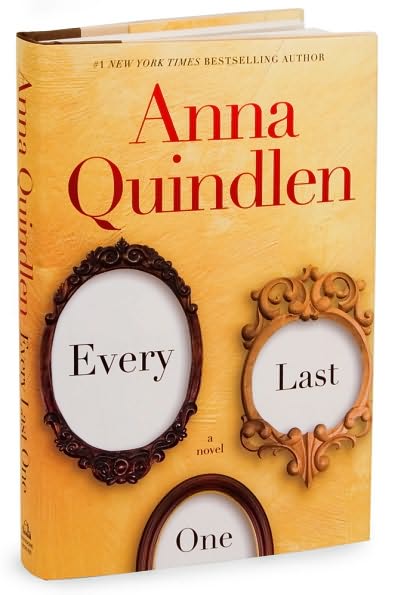
Every Last One is already slipping from memory, unlike Quindlen's One True Thing, which I think is excellent.  The one long quote I copied from this book is also a spoiler, so I can't share the whole thing.  But (as a teaser) I'll give you the last sentence of that quote:  "Every last one," says a different voice (p. 155).  And that's where the title comes from.  Rated:  8 of 10.

And now for the rest of 'em:

The Cougar Club ~ by Susan McBride, 2010
The Cougar Club is pure fluff, and I only finished it because I won it during Dewey's Read-a-Thon, paired with another book (which was worth winning). I even debated whether I wanted to include it on my list of Summer Reading that the librarians would see!  Not my kind of book.  Do you know what a "cougar" is?  I didn't know it's a woman who dates (or more exactly, sleeps with) a much younger man.  No review because it would be such a pitiful report.  Rated:  "nah."
The Smoke Jumper ~ by Nicholas Evans, 2001
I mostly enjoyed The Smoke Jumper while reading it, but it's forgettable.  An average kind of story, maybe a beach read.  It's for folks who like action, as in jumping out of planes into the middle of a forest fire.  I can't really get excited enough to tell you more than that.  Rated:  "nah."
Shanghai Girls ~ by Lisa See, 2009
Shanghai Girls is pretty good, but I liked Lisa See's Snow Flower and the Secret Fan more. I took notes because I read this book with both my face-to-face book club and with my online Book Buddies (click that link for more), but not a lot of notes. I learned about Angel Island, the West coast equivalent of Ellis Island in New York. Rated: 7 of 10.
The Road Taken ~ by Rona Jaffe, 2000
I really liked The Road Taken while reading it, but I'd be hard pressed (already) to tell you much about the book.  In the very last sentence, Rose thinks:  "She wanted to tell them about her rich and vivid and vanished world before it was too late, before she was gone, before it was all forgotten" (p. 388).  Oops!  I've already forgotten nearly everything I read about Rose's world, which pretty much covered the whole twentieth century.  The best of the quotes I wrote out comes from when Rose was ten years old:  "God killed her.  In order to 'take' her he had to kill her.  I'm not so stupid as not to know that.  Of course she could never tell anyone how she felt; you were supposed to love God, even when he killed your mother" (p. 4).  Rated:  7 of 10.

Two Rivers ~ by T. Greenwood, 2009
Same with Two Rivers, which I thought was great as I was reading it, but now I have forgotten details.  A train derails into a river; a girl named Marguerite shows up, presumably from the train wreck.  She's taken in by the main character, who works for the railroad.  The book is easy to read, and I finished thinking the "two rivers" were a metaphor for two strands in the book.  I wrote a teaser about Shelly's essay on Lincoln.  Here she is again:  "Shelly set her utensils down, pressed her palms together, and closed her eyes.  'Father, bless the food we take, and bless us all for Jesus' sake. Amen.' ... Marguerite leaned over to her and said, 'At my house we say, 'For bacon, eggs and buttered toast, praise Father, Son and Holy Ghost'" (p. 56).  Rated:  7 of 10.
The Good Man Jesus and the Scoundrel Christ ~ by Philip Pullman, 2010
This one has a premise that is unforgettable -- that Jesus had a twin, nicknamed Christ, who wrote down the things Jesus said. But the story wasn't all that good.  I'll share a quote, where Jesus is praying:
"'Lord, if I thought you were listening, I'd pray for this above all:  that any church set up in your name should remain poor, and powerless, and modest.  That it should wield no authority except that of love.  That it should never cast anyone out.  That it should own no property and make no laws.  That it should not condemn, but only forgive" (p. 199).
Interesting idea, but boring presentation.  Rated:  "nah."
Daughter of God ~ by Lewis Perdue, 2000
Oops!  Daughter of God was so forgettable that it didn't even make the list (in my response to Helen's question).  Thrillers do that to me.  They are interesting while I'm reading, but don't really make me think.  From the dustjacket:  "The Vatican has lost its most closely held secret -- a secret whose exposure could shatter the very foundations of Western religion..."  Blah-blah-blah.  The secret is "proof of a female Messiah named Sophia."  It sounds like something I'd remember, huh?  But this is no challenge to the Da Vinci Code.  Rated:  "nah."
When I realized this "report" to Helen was like a bunch of mini-reviews, I decided to post them that way, as mini-reviews.  Hope you like this way of covering a baker's dozen I've read recently.

Thursday, July 15, 2010

My newest books

I dropped by the library today, and the librarian who helps me find books for the Women Unbound reading challenge gave me one of her own books she had just finished:  Red Azalea (1994), Anchee Min’s celebrated memoir of growing up in the last years of Mao’s China.  The online synopsis says:
"As a child, she was asked to publicly humiliate a teacher; at seventeen, she was sent to work at a labor collective. Forbidden to speak, dress, read, write, or love as she pleased, she found a lifeline in a secret love affair with another woman. Miraculously selected for the film version of one of Madame Mao’s political operas, Min’s life changed overnight. Then Chairman Mao suddenly died, taking with him an entire world."
I've read several books by John Shelby Spong, but not this one.  I ran across Liberating the Gospels (1996) when I was at the bookstore with my friend Donna the other day.  The subtitle is "Reading the Bible with Jewish Eyes."  Since I'm working on the course I'll be teaching on "Seven Gospels," I figured it was right up my alley.  Spong says the Gospels are thoroughly Jewish texts.  The online synopsis says:
"Spong powerfully argues that many of the key Gospel accounts of events in the life of Jesus—from the stories of his birth to his physical resurrection—are not literally true. He offers convincing evidence that the Gospels are a collection of Jewish midrashic stories written to convey the significance of Jesus."
I've already told you I'm reading Wintergirls by Laurie Halse Anderson (2009).  This book is one Donna bought new and decided to let me read first.  She knows how impressed I am by this author's writing.

I finished Summer's End by Audrey Couloumbis (2005) within hours of Donna's lending it to me.  Yep, I told you I'd read this one, but I plan a short review soon.  (Oh, so many reviews I mean to write!)
----------------------------------------------------------------------------------
Remember when you were a kid and getting new crayons was a big deal?  Getting new books holds the same kind of magic for some of us big kids.  Susan at Color Online came up with the idea of New Crayons as a metaphor for the new books that have arrived at your house.
----------------------------------------------------------------------------------

Sunday, June 20, 2010

What's new on my bookshelves

The complete title of this book is rather long, when I include the subtitle:  The Gnostic Gospels of Jesus: The Definitive Collection of Mystical Gospels and Secret Books about Jesus of Nazareth ~ by Marvin Meyer, 2005.  Meyer offers fresh translations of a dozen books, most of which were found at Nag Hammadi in the Egyptian desert in 1945.

My interest in this area started when I read the then-newly published The Gnostic Gospels, a scholarly book by Elaine Pagels (1979) which won the National Book Critics Circle Award and the National Book Award and was chosen by the Modern Library as one of the hundred best books of the twentieth century.  Many years later, I also read her bestseller, Beyond Belief: The Secret Gospel of Thomas (2003), in which she says the Gospel of Thomas reveals, along with other apocryphal teachings, that Jesus was not God but rather a teacher who sought to uncover the divine light in all human beings.  She argues that the Gospel of John was written as a reaction and rebuttal to the Gospel of Thomas.

This sort of thing fascinates me, so I developed a class about "Six Gospels," using the four gospels that made it into the Christian Bible (Matthew, Mark, Luke, and John) along with two of the gospels found at Nag Hammadi:  The Gospel of Thomas and the Gospel of Mary (Magdalene).  For later classes, I decided to include a gospel by James, the brother of Jesus.  James was the leader of the church in Jerusalem, which was decidedly on the side of Christians conforming to Jewish customs, like circumcision.  Now I want to read Meyer's new translation and see what I notice this time around.  If you are interested in attending the class when I teach it again, let me know.

----------------------------------------------------------------------------------
Remember when you were a kid and getting new crayons was a big deal?  Getting new books holds the same kind of magic for some of us big kids.  Susan at Color Online came up with the idea of New Crayons as a metaphor for the new books that have arrived at your house.
----------------------------------------------------------------------------------

Wednesday, June 9, 2010

Book arrivals

Ain't I a Woman: Black Women and Feminism by bell hooks (1981) includes these chapters:
  • Sexism and the Black Female Slave Experience
  • Continued Devaluation of Black Womanhood
  • The Imperialism of Patriarchy
  • Racism and Feminism: The Issue of Accountability
  • Black Women and Feminism
    The next three books fit the World Religion reading challenge.

    A friend gave me The Visual I Ching: A New Approach to the Ancient Chinese Oracle, with cards and commentary by Oliver Perrottet. The boxed set includes not only the book, but a set of cards and a cloth for laying out the cards. A quick perusal gives me the impression that this system may be more complicated than the usual I Ching that I've seen, but I'm curious and willing to give it a try.  I must say the cards are really beautiful.

    The other two are library books for children, but I have long been interested in the variety of creation stories in the world -- and I know nothing (so far) about Mayan gods and goddesses:

    Gods and Goddesses of the Ancient Maya ~ by Leonard Everett Fisher, 1999
    From the dustjacket:  "The Ancient Maya created a remarkable civilization, one known for its skill at astronomy, mathematics, and building.  Their pyramids still dot the landscape of Central America, where they flourished more than a thousand years ago. ... Fisher describes twelve of the most important Maya gods, explaining their powers, their gifts, and their images."
    In the Beginning: Creation Stories from Around the World ~told by Virginia Hamilton and illustrated by Barry Moser, 1988
    Twenty-five creation myths have been collected, and every one has at least one illustration.  The dust jacket gives some examples:  "In an Eskimo myth, for example, the first man pushes his way out of a pea pod.  In a story from the Kono people of Guinea, death starts the world.  A dramatic myth from China tells that the universe was originally in the shape of a hen's egg -- and from this burst the first being."
    We've been hearing warnings since the late 1970s about climate change, and I've heard this book is good.  Field Notes from a Catastrophe: Man, Nature, and Climate Change by Elizabeth Kolbert was published in 2006, and I'm finally getting around to reading it.  At 194 pages, plus notes and index, it's smaller than I expected.  The book looks very reader-friendly and inviting, so maybe it won't take me very long to read through it.

    ----------------------------------------------------------------------------------
    Remember when you were a kid and getting new crayons was a big deal?  Getting new books holds the same kind of magic for some of us big kids.  Susan at Color Online came up with the idea of New Crayons as a metaphor for the new books that have arrived at your house.
    ----------------------------------------------------------------------------------

    So what new books have you gotten lately?

    Sunday, May 23, 2010

    Newest book arrivals

    The Secret Supper ~ by Javier Sierra  (2004):
    "Milan, 1497:  Leonardo da Vinci is completing his masterpiece, The Last Supper.  Pope Alexander VI is determined to execute him after realizing that the painting contains clues to a baffling — and blasphemous — message, which he is determined to decode.  The Holy Grail and the Eucharistic Bread are missing, there is no meat on the table and, shockingly, the apostles are portraits of well-known heretics — none of them depicted with halos.  And why has the artist painted himself into the scene with his back turned toward Jesus?  The clues to Leonardo's greatest puzzle are right before your eyes."
    The Smoke Jumper ~ by Nicholas Evans (2001):
    "The fire that was to change so many lives so utterly started with a single shaft of lightning. ... The woman, camped nearby with her group of troubled teenagers, slept on and heard nothing.  She has brought them here by court order on a youth program to help them find themselves.  But one among them will be lost forever.  For soon the cocoon of fire will hatch to engulf the entire mountain and exact its deadly toll.  And into this inferno will come the smoke jumper.  His name is Connor Ford and he falls like an angel of mercy from the sky, braving the flames to save the woman he loves but knows he cannot have.  For Julia Bishop is the partner of his closest friend, Ed Tully, an ambitious young musician.  Julia loves them both but the tragedy on Snake Mountain forces her to choose between them..."
    A Vindication of the Rights of Woman ~ by Mary Wollstonecraft (1792) is one of the earliest books on feminist philosophy. Wollstonecraft argues that women must be educated according to their class, since they had the major responsibility for educating the nation's children. Women are not ornaments or property to be traded in marriage, but human beings who deserve the same fundamental rights as men.
    ----------------------------------------------------------------------------------
    Remember when you were a kid and getting new crayons was a big deal?  Getting new books holds the same kind of magic for some of us big kids.  Susan at Color Online came up with the idea of New Crayons to represent new books that arrived during the week.
    ----------------------------------------------------------------------------------

    Sunday, May 9, 2010

    New books (like new crayons) are such a pleasure!

    Several books arrived at my house this week.  I'll start with one I won from Color Online.

    Page from a Tennessee Journal, a novel by Francine Thomas Howard (2010), is loosely based on a well-guarded family secret, we are told on the page about the author.  Rural Tennessee in 1913, black woman sharecropper trying to feed her children after her husband runs off, white landowner who gets her pregnant -- one reviewer on Amazon.com posted a quote from the book, about what the woman's Aunt Becky said:
    "Ain't never been a brown-skinned woman who had any say over what a Tennessee white man can do with her body."
    But it isn't as simple as that, apparently, when we throw in the spouses.  I'll let you know what it's all about, after I read the book.

    I ran across Woman's Inhumanity to Woman by Phyllis Chesler while reading about feminism in relation to the Women Unbound reading challenge.  Luckily, my library had a copy.
    "Like men, women are exposed to the messages of misogyny and sexism that permeate cultures worldwide. Like men, women unconsciously buy into negative images that can trigger abuse and mistreatment of other women. But like other social victims, many do not realize stereotyping affects members within the victimized group as well as those outside the group. They do not realize their behavior reflects society's biases."
    I am working at my branch of the public library, as a volunteer -- two days this week, and two more next week -- so one of the three employees could take a vacation.  I was telling someone about Laurie Halse Anderson, one of my favorite authors, and showed the woman the two of her books on the YA shelves that were not checked out:  Speak, which I've read (and reviewed), and Chains, which I haven't.  Are you surprised to learn that I checked out Chains myself?  I didn't think you would be.

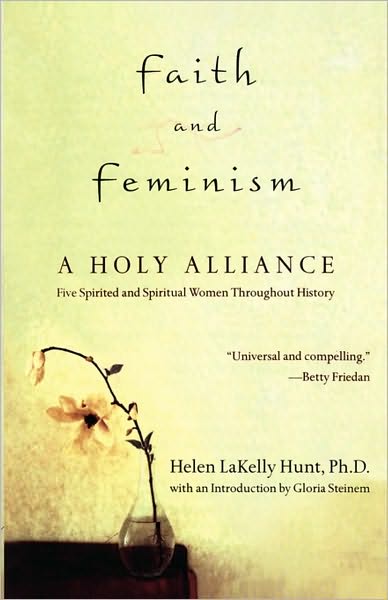
    I read about Faith and Feminism on Ronna Detrick's blog and immediately put the book on hold at my library.  Two questions seem to be at the heart of the book, according to the back cover:
    "Why do so many women of faith have such a strong aversion to feminism?  And why do so many feminists have an ardent mistrust of religion?"
    The book takes a look at five spiritual women who combined their faith with feminist beliefs:  Emily Dickinson, Teresa of Avila, Sojourner Truth, Lucretia Mott, and Dorothy Day.  And I like the title of the last chapter:  "Weaving a Connection."

    I'm still emptying boxes of books from my storage units.  One book I added to my TBR pile was Networking: The Great New Way for Women to Get Ahead.  I hear you thinking, "Networking is not new!" and you're right.  But this book by Mary Scott Welch was published in 1980, thirty years ago.  That was decades before Facebook, Twitter, and other social networking sites.  I'm curious to see how it all started.  When the author died in 1995, at the age of 75, the New York Times obituary said:
    "Ms. Welch wrote Networking: The Great New Way for Women to Get Ahead (Harcourt, Brace, Jovanovich, 1980) in an era when more women were competing for jobs traditionally dominated by men.  Networking, through individual contacts and professional organizations, became an important technique for women to get career advice and make connections. Such contacts also helped offset the competitive advantage men often enjoyed through their own 'old boy' network.
    Based on this cover and even the title -- Clone Codes by Patricia C. McKissack, Fredrick McKissack, and John McKissack -- this doesn't sound like my kind of book at all, but I've nearly finished reading this YA novel.  Here's the online synopsis of the story:
    The Cyborg Wars are over and Earth has peacefully prospered for more than one hundred years. Yet sometimes history must repeat itself until humanity learns from its mistakes. In the year 2170, despite technological and political advances, cyborgs and clones are treated no better than slaves, and an underground abolitionist movement is fighting for freedom. Thirteen-year-old Leanna's entire life is thrown into chaos when The World Federation of Nations discovers her mom is part of the radical Liberty Bell Movement. ... With help from unlikely sources, Leanna learns the origin of The Liberty Bell Movement and how its members may have answers about her past-and her new reality.As family secrets are revealed, Leanna must face startling truths about self-identity and freedom. Through time travel, advanced technologies, and artificial intelligence, this exhilarating adventure asks what it means to be human and explores the sacrifices an entire society will make to find out.


    Another book from the library this week was Full, Full, Full of Love by Trish Cooke, which I've already read and reviewed here.  It's a great little children's book that I highly recommend.
    ----------------------------------------------------------------------------------
    Remember when you were a kid and getting new crayons was a big deal?  Getting new books holds the same kind of magic for some of us big kids.  Susan at Color Online came up with the idea of New Crayons to represent new books that arrived during the week.
    ----------------------------------------------------------------------------------

    Monday, April 26, 2010

    New Crayons ~ what's new on my bookshelves

    Remember when you were a kid and getting new crayons was a big deal?  Getting new books holds the same kind of magic for some of us big kids.  Susan at Color Online came up with the idea of New Crayons to represent new books that arrived during the week.
    ----------------------------------------------------------------------------------

    I got a half dozen new books this week.  My friend Donna took me to lunch today and gave me books, plus this big Happy Birthday cookie (yes, as you can see, I turned 70 today).

    Donna also knows the kind of books I like.
    The Pillars of the Earth, a novel by Ken Follett (1989), tells the story of Philip, "a devout and resourceful monk driven to build the greatest Gothic cathedral the world has known."  BN.com says, "As a new age dawns in England's twelfth century, the building of a mighty Gothic cathedral sets the stage for a story of intrigue and power, revenge and betrayal."  The back cover promises "a struggle between good and evil that will turn church against state and brother against brother."  This sounds like one for the World Religions Challenge.

    Jimmy Carter's Our Endangered Values: America's Moral Crisis (2005) may also work for the World Religions Challenge.  Like in the other book Donna gave me, Carter "puts forth a passionate defense of separation of church and state, and a strong warning of where the country is heading as the lines between politics and rigid religious fundamentalism are blurred.  Many of the "moral values" he examines are under fierce debate:  preemptive war, women's rights, terrorism, civil liberties, homosexuality, abortion, the death penalty, science and religion, environmental degradation, nuclear arsenals, America's global image, fundamentalism, and the melding of religion and politics.
    The next two books came from the library:
    Kate Klise's novel, Trial by Journal (2001), is told through journal entries, news clippings, and letters.  The book is illustrated by the author's sister, M. Sarah Klise.  I'm curious about this one because I've never heard of a sixth grader being sequestered with a jury.  The whole thing gets "curiouser and curiouser" (as Alice would say) when I read that "twelve-year-old Lily finds herself on the jury of a murder trial while conducting her own undercover investigation of the case."  Hmm, my understanding of "sequestered" wouldn't allow that to happen, making an undercover investigation even MORE unlikely.  Still, I'm curious and willing to suspend my disbelief long enough to find out what happens.

    Bare Your Soul: The Thinking Girl's Guide to Enlightenment, edited by Angela Watrous (2002), came from the library.  I've already started reading this one for the World Religions Challenge, based on this from the back cover.  It may even work for the Women Unbound reading challenge.  "Whether raised within a specific belief system or warned against all things religious, women today have been left with questions and conflicts that dating guides and pop feminism can't resolve.  This essential collection includes narratives from skeptics, reformists, and neo-traditionalists alike, representing a wide spectrum of traditions and practices -- from Buddhism to Islam, Judaism to Goddess worship, Catholicism to atheism, and many others.  Wise, compelling, and open-minded, Bare Your Soul offers a provocative look at the ways in which a new generation of women both celebrate and repudiate religion -- and, ultimately, find answers that fit."
    I can't put the next book down -- it's that good.  My online book club will discuss it in May, and I posted a teaser about it yesterday. 
    House Rules by Jodi Picoult (2010) is a novel about Jacob Hunt, a teenage boy with Asperger's syndrome.  "He's hopeless at reading social cues or expressing himself well to others, and like many kids with AS, Jacob has a special focus on one subject -- in his case, forensic analysis.  He's always showing up at crime scenes, thanks to the police scanner he keeps in his room, and telling the cops what they need to do ... and he's usually right.  But then his town is rocked by a terrible murder and, for a change, the police come to Jacob with questions" ... and then they charge him with murder.
    I'll have to explain why I call this last book a "new" one at my house.  Although I bought it in 1977 (I wrote the date in the front of the book), I never got around to reading it and it's been in a box in a storage unit for several years.  I've been sorting out old books and taking them to trade at the used book store, but when I came across this one, I set it aside to read first.
    Son of Man by Robert Silverberg (1971) is science fiction, though the blurb on the back cover sounds more like what I prefer to call speculative fiction.  "In the beginning there was no Brooklyn, no St. Louis, no Shakespeare, no moon, no hunger, no death ... In the beginning the heavens, the seas, and the earth belonged to more intelligent species than a man called Clay could ever have dreamed possible in his own time ... but his own time as a man had passed, and now his time as the son of man had come!"
    What new books have you gotten this week?