Friday, March 31, 2017

Interfaith Relations ~ meditation on Surah 29.46


Allah: A Christian Response ~ by Miroslav Volf (2011), from page 25:
...be governed by the injunction in the Qur'an about debating with Jews and Christians:  "Do not contend with people of the Book except in the fairest way" (Al 'Ankabut, 29:46).


When I read that line, I got out my two copies of the Qur'an to compare translations and interpretations.  Then I read that the translation by Abdullah Yusuf Ali is considered to be the most faithful rendering available in English, so I downloaded it onto my Kindle while writing this post.  Here are the three versions I now have to compare with Volf's version of Surah 29:46 above:


The Holy Qur'an ~ by Abdullah Yusuf Ali (1934), from Loc. 4196:
Chapter 29
46.  And dispute ye not with the People of the Book, except with means better (than mere disputation), unless it be with those of them who inflict wrong (and injury): but say, "We believe in the revelation which has come down to us and in that which came down to you; Our Allah and your Allah is one; and it is to Him we bow (in Islam)."
The Message of the Qur'an: The Full Account of the Revealed Arabic Text Accompanied by Parallel Transliteration ~ translated by Muhammad Asad (2003), from pages 684-685:
Surah 29
And do not argue with the followers of earlier revelation otherwise than in a most kindly manner ― unless it be such of them as are bent on evildoing ― and say:  "We believe in that which has been bestowed from on high upon us, as well as that which has been bestowed upon you: for our God and your God is one and the same, and it is unto Him that we [all] surrender ourselves."  {46}
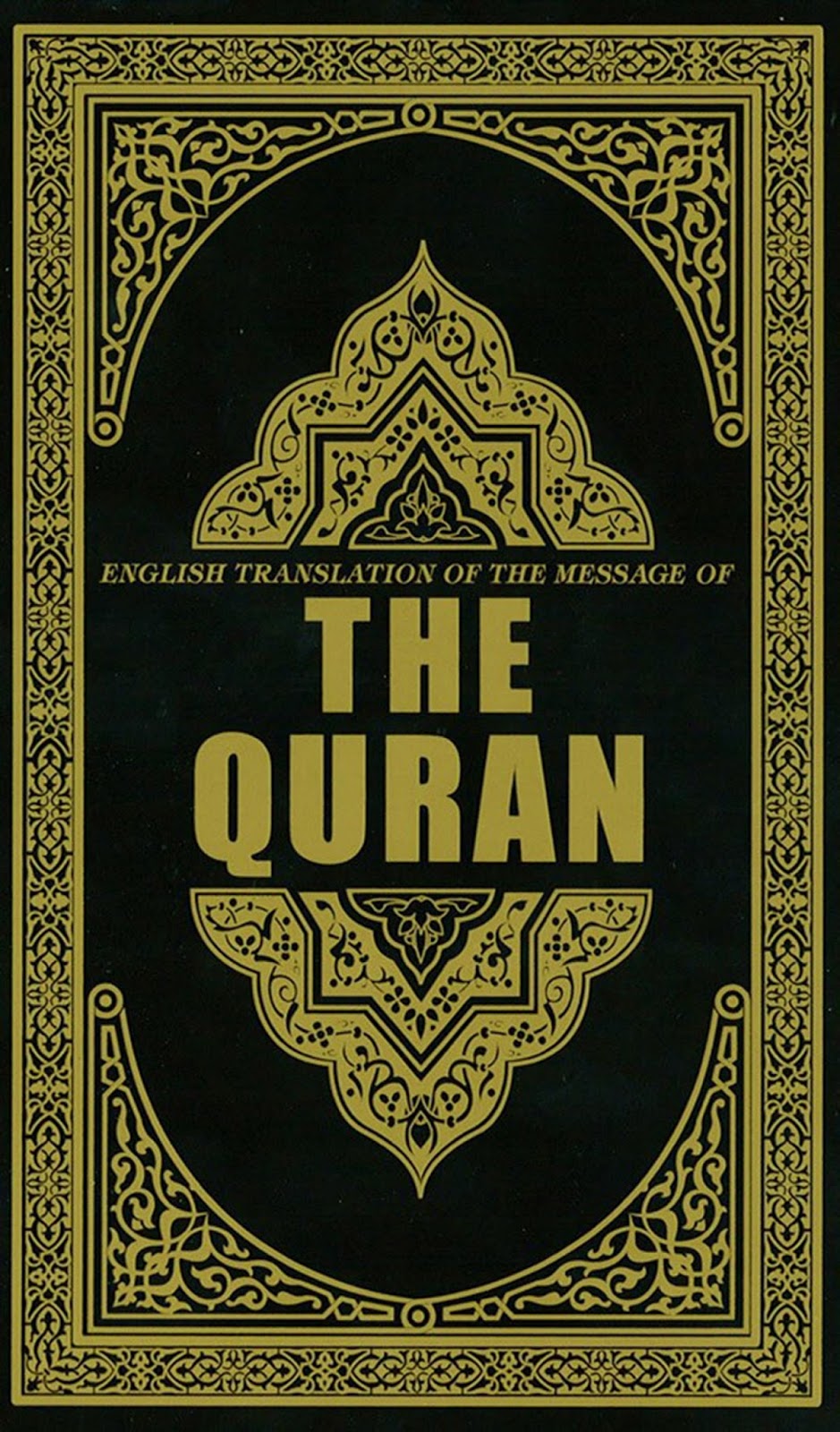
English Translation of the Message of The Quran ~ by Syed Vickar Ahamed (2007), from page 223:
29.46.  And you do not argue (or dispute) with the People of the Book, except with better ways (reasons and facts); Unless it is with those of them who cause injustice (or injury): But say (to them), "We believe in the Revelation which has come down to us and in that which came down to you; Our God (Allah) and your God is One; And it is to Him we bow (in Islam)."
Meditating on what these say:  "People of the Book" means the three monotheisms of Judaism, Christianity, and Islam.  Each of these religions has a holy book.
  • Judaism has the Tanakh, holy scriptures made up of the Torah (the Law, also known as the five books of Moses), the Prophets, and the Writings.
  • Christianity has the Bible, which contains the Hebrew scriptures (usually called the Old Testament) and the New Testament with four Gospels and other writings.
  • Islam has the Qur'an, made up of 114 Surahs or chapters.  I've read the scriptures of the other two religions, and now I plan to read the Qur'an with a couple of friends.
We worship the same God, according to this verse.  Many would disagree, but I think we do.  If you want my reasoning, it will take another post to share all that.

Sunday, March 26, 2017

Sunday Salon ~ eating out and reading

My life outside books

Eating out with friends
When Barbara found out Joan would be moving in a couple of days, she set up one last meal together.  Joan moved to Montana yesterday.  Barbara took this picture of Donna and Joan and me at OB Clark's.

Although I don't have photographs to share, I also ate out this week with a bus-load of folks at Rib City, with Joan for lunch at Pumpernickles Deli, with Miriam and her friend Arlene at the St. Louis Bread Company before an event by the Holocaust Memorial Museum at our library, and with Donna at Sonic after seeing the movie "Fences."  I'm not sure who's going to Chevy's Fresh Mex for dinner this evening on the Crown Center bus, but I'll be there.  And this list doesn't include the evenings I choose to eat at the Crown Center with other residents and people from the community.  As you can see, I haven't done a lot of cooking lately.

My life in books

Books I've completed since last week's Sunday Salon:

22.  Tao Te Ching: A New English Version ~ by Stephen Mitchell, 1988, religion, 9/10
"Those who know don't talk.
Those who talk don't know" (#56).
Po Chu-i, poet and stand-up comedian, wrote,
"He who talks doesn't know,
he who knows doesn't talk":
that is what Lao-tzu told us,
in a book of five thousand words.
If he was the one who knew,
how could he have been such a blabbermouth?  (p. 85).


23.  Two Tyrants: The Myth of a Two Party Government and the Liberation of the American Voter ~ by A.G. Roderick, 2015, politics, 9/10
"Educational accomplishment, social mobility, and economic stability should be bastions of American achievement" (p. 7).

24.  The Boy No One Loved ~ by Casey Watson, 2011, memoir (England), 9/10
"If there's one thing that absolutely must come out of this is that he knows there are people here who love him unconditionally, and that we will always be here for him.  Always" (p. 269).

Bloggers gather in the Sunday Salon — at separate computers in different time zones — to talk about our lives and our reading.

Saturday, March 25, 2017

May the love of God enfold you

May the love of God enfold you
as you journey home to big sky country,
where your doggie awaits,
not knowing you're on your way!

Caturday ~ window cat

Bonnie told me she and Miriam were talking about how hard it is to open the windows in our building, so I thought I'd show everybody how it's done.  See?  Simple!

Clawdia, 'til next time   >^. .^<

Friday, March 24, 2017

Beginning ~ with its strangeness


The Lord's Prayer is Christianity’s greatest prayer.  It is also Christianity’s strangest prayer.  It is prayed by all Christians but it never mentions Christ.  It is prayed in all churches but it never mentions Church.  It is prayed on all Sundays but it never mentions Sunday.  It is also called the “Lord’s Prayer” but it never mentions “Lord.”


The Greatest Prayer: Rediscovering the Revolutionary Message of the Lord's Prayer ~ by John Dominic Crossan, 2010
Crossan intimately explores the revolutionary meaning of the cornerstone of Christian faith: The Lord’s Prayer.
I'm especially intrigued by this sentence, also near the beginning of the book:
"Just as the content of the Lord's Prayer is deeply embedded in the biblical tradition of justice, so is its format deeply embedded in the biblical tradition of poetry" (p. 3).
Biblical poetry is created with parallelism, about which Crossan says:
"...the parallelism creates a vibration of thought, a metronome in the mind" (p. 4).


Gilion at Rose City Reader hosts Book Beginnings on Fridays.  Click here for today's Mister Linky.

Wednesday, March 22, 2017

Wednesday Word ~ truculent

truculent ~ adjective ~ eager or quick to argue or fight; aggressively defiant.
  • Example:  "His days of truculent defiance were over."
  • Synonyms:    defiant, aggressive, antagonistic, combative, belligerent, pugnacious, confrontational, ready for a fight, obstreperous, argumentative, quarrelsome, uncooperative; bad-tempered, ornery, short-tempered, cross, snappish, cranky; feisty, spoiling for a fight.
  • Another example:  "A number of staffers have complained that Wilson is too truculent to work with."

Monday, March 20, 2017

Meditating ~ Tao Te Ching 17

When the Master governs, the people
are hardly aware that he exists.
Next best is a leader who is loved.
Next, one who is feared.
The worst is one who is despised.

If you don't trust the people,
You make them untrustworthy.

The Master doesn't talk, he acts.
When his work is done,
the people say, "Amazing:
we did it, all by ourselves!"
__________

Acting simply
True leaders
are hardly known to their followers.
Next after them are the leaders
the people know and admire;
after them those they fear;
after them, those they despise.

To give no trust
is to get no trust.

When the work's done right,
with no fuss or boasting,
ordinary people say,
Oh, we did it.
__________

With the highest kind of rulers, those below simply know they exist.
With those one step down ― they love and praise them.
With those one further step down ― they fear them.
And with those at the bottom ― they ridicule and insult them.

When trust is insufficient, there will be no trust in return.
Hesitant, undecided!  Like this is his respect for speaking.
He completes his tasks and finishes his affairs,
Yet the common people say, "These things all happened by nature."
__________

1.  The best government, the people know it is just there.
The next best, they love and praise it.
The next, they fear it.
The next, they revile against it.

2.  When you don't trust [the people] enough,
Then they are untrustworthy.
Quiet, why value words?

3.  Work is accomplished, things are done.
People all say that I am natural.
__________

Top to bottom:
  • Tao Te Ching: A New English Version ~ by Stephen Mitchell, 1988
  • Lao Tzu: Tao Te Ching: A Book about the Way and the Power of the Way ~ by Ursula K. Le Guin, 1997
  • Lao-Tzu: Te-Tao Ching: A New Translation Based on the Recently Discovered Ma-Wang-Tui Texts ~ by Robert G. Henricks, 1989
  • The Tao Te Ching: A New Translation with Commentary ~ by Ellen M. Chen, 1989